

No matter what kind of television you like to watch, chances are that you know who Amelia Bullmore is. The hugely versatile actress's filmography includes hit shows such as Happy Valley, Vienna Blood, Twenty Twelve, and most recently, BBC’s hit series Riot Women – and ahead of the latter's second season, she is set to star as Penelope in Margaret Atwood's The Penelopiad.
Chatting to HELLO!, Amelia opened up about telling The Odyssey from a female perspective, her singing chops, her working relationship with Happy Valley creator Sally Wainwright – and shared an insight into the return of Riot Women...
What was it about this role that made you want to go back and tread the boards for the first time in eight years?
It's an amazing play. It's a really surprising, unusual play, and the character is the same: surprising, contradictory, funny, flawed, clever, and very perceptive, but [Penelope] also has a huge blind spot. Because it's Margaret Atwood, she’s got that incredible mixture of an unflinching gaze on the world, but she's funny. She gets it, she skewers it, but somehow or another, she's playful along the way.
 © PAMELA RAITH
What Penelope has on her side is her status and her class, and the maids don't have any of that. However much she's fond of them, she can't really see the wood for the trees; she can't appreciate the very, very different experience they have. Again, that's so Atwood-y: the sisterhood is fragile. It's not cosy at all, and she doesn't tidy anything up.
 © PAMELA RAITH
As a playwright yourself, do you think your background in writing influences how you're approaching Atwood's work?
I think it's a circular thing. If you love stories, you're always looking for what the character is doing, what's going on here, what's to be dug up here, what the scene is doing, and what the character is doing. You ask those same questions whether you're trying to set that down on paper or whether you're trying to realise what someone has already put down on paper. There's such a massive crossover between the two.
 © PAMELA RAITH
Not that I could do what Margaret Atwood does, but you can marvel at it. You can marvel at how a lyric is making you laugh one minute, and then you feel a bit sick the next minute. She's just got your attention, and then she plays with it.
This company, we've all got pencil cases! We're sitting there with our pencils and our highlighters, sitting round in a circle learning the songs. It's very sweet, very fun, and very stimulating because you're all just nerding out on this thing that you're excited about. It really gets you going - it's very buzzy.
Are you singing in the play?
A tiny bit! I love singing, and I'm scared of it! It's come my way, but I don't have musical theatre chops at all. I can just about sell a song as a character, but I couldn't tackle anything more!
Throughout your career, you've played a huge range of women – often powerful women in very different ways. How does Penelope compare, and what would you say are some of your favourite roles?
What she's got in common with some of my favourite roles is how contradictory she is, which I think is a really, really good sign that a character is well thought-through and well-written.
People are contradictory, mysterious, and strange. People you know very, very well can do something you didn't see coming. People have secret corners, a version of themselves they're hoping to present, and a version they're reluctant to present.
 © CREDIT LINE:BBC/Firebird Pictures/Matt Towers
I think all well-written characters are confusing and, in the end, kind of unpin-downable. It's very enjoyable to do because you can get into all sorts of corners, and you don't have to really worry about the effect that's having. If you just get behind all those different notes and flavours, the rest will sort itself out.
Why do you think audiences in 2026 are so hungry for these Greek epic retellings?
It was amazing to see [The Odyssey] a couple of weeks ago—it was absolutely spectacular, I really enjoyed it… You're sort of vibrating with the action.
 © The Odyssey
It's got an amazing combination. Firstly, because it's mythical, magical, and impossible, you've got a great escape through that—a place of monsters, goddesses, and impossible extremes. But at the same time, people are people: they're vain, greedy, frightened, or lustful. So it's a very compelling mix of pretend, but with humans and monsters.

I began to read because I wasn't very clued up on the myths at all… That is a huge body of work—women writers revisiting the myths. I think Penelope has been a great source of curiosity for painters and writers, but I don't know of another play that deals with it with this daring mixture of tone.
How do you think the TV landscape has changed for female writers over the years, and how are women represented on screen?
I happen to have worked with tons of women on female-led projects, with female producers, on scripts written by women. Women especially love TV drama—they are the mainstay of the audience, and everybody making TV knows that. There are lots of strong female characters offered up.
Maybe what is still the case is that you'll get a strong female-led piece as its USP, and then another piece in a more masculine vein with more sidekick female characters. Maybe what we haven't quite got is the great blend. Often in comedy they do it, like Schitt's Creek or Widow's Bay - everybody gets a good run for their money, and that's such a pleasure to see.
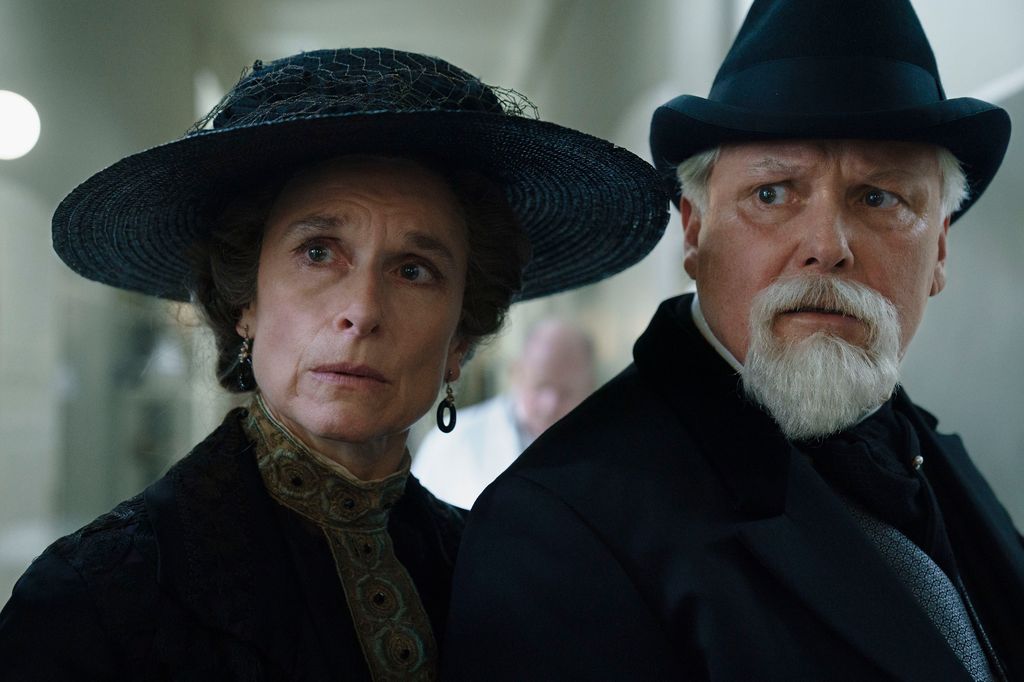 © Endor Productions / MR Film / Petro Domenigg
Can you tell me a little bit about your working relationship with Sally Wainwright over the years?
Talking about reading a script and thinking how great a character is because of the contradictions—that is definitely what I thought when I read for Gill Murray in Scott & Bailey. I just loved that she could be very funny, warm, and approachable, and then ruthlessly tough about procedure… Just the range of things she did and was, I was really impressed by that.
 © Alamy Stock Photo
I got lucky because I went up for it in person, but there were some crossed wires. The message I got through was that they were looking for a bit more toughness. So I dressed a bit tougher! Then on my way in, I happened to meet the casting director in the loo. I said, "I gather you're looking for a bit more toughness today," and she said, "No, we're looking for a bit more humour!" So that was such a lucky chat in the loo!
And your role in Happy Valley is somewhat iconic. What are your memories of doing it?
I was absolutely thrilled to do it. What Sally wants from you, given that she can hear every beat, is that you just have to do it as it is. John Morton (Twenty Twelve) is the same. Their writing has such precise rhythms—it's kind of like a musical score, and you just have to plug into the rhythm.
 © Alamy Stock Photo
It's exacting, but you really get into it because that's a million times better than reading a script that's sketchy or approximate. You get a Sally script, and she has poured her brain into it. She's hearing those comic beats, the dark beats, the rhythms of conversation. A Sally scene can go on longer than you expect, like conversations do.
You'll think of something you said two minutes ago that you now disagree with, and you'll go back to it. She's just got a great ear for the messy tangle of conversation.
Have you continued practising the guitar for Riot Women, and what can you tell us about Season 2?
I have continued practising the guitar – number one because I loved it, number two because having learned something from scratch it seemed a sinful waste to drop it, and number three because I hoped we would need it again!
As for Season 2, I fear I can't say anything at all! We don't start until February, so in the autumn we'll start to get the songs through and get our homework for the music, and then we'll be back in Hebden.


