


It is only 13 years since the Prince of Wales, then the Duke of Cambridge, was gingerly strapping Prince George’s baby seat into the back seat of his car to take him home for the first time. Last week, he and the Princess of Wales found themselves faced with the bittersweet prospect of waving their firstborn off to boarding school.
While George may well return home to visit within weeks, it marks the end of an era for the Wales family. But it also signals the start of an exciting new chapter and a significant next step in the journey of the boy who will one day be king.
Wearing a dark-blue suit and tie and almost matching his mother in height, the 13-year-old prince smiled broadly as he arrived at Eton College with his parents amid pouring rain. Catherine, in a dark green dress, shared her umbrella with George, who giggled as his father briefly wrestled with his own.
 © Getty
In the historic quadrangle, overlooked by a statue of King Henry VI, who founded Eton in 1440, and the school’s magnificent Chapel, George shook hands with the headmaster, Simon Henderson, and the provost, Sir Nicholas Coleridge, who is also chairman of The King’s Foundation. “Welcome,” the headmaster told him. “Enjoy it.”
Catherine put a protective arm on her son’s back as they disappeared into the fourth form passage in the original school building. If the moment was emotional for his proud parents, who will no doubt miss their son enormously, they did not show it.
The Prince and Princess stayed on to help George settle into his new bedroom before he spent time with other first-year pupils – known collectively as “F Block”. Later that day, Kensington Palace shared three striking new portraits of George wearing the very traditional uniform of a black tailcoat, white shirt, stiff “Eton” collars and white tie.
Taken by Matt Porteous, who has so often captured important moments in the Wales family’s life, they show the teenage prince looking happy and relaxed in his new surroundings and bearing a strong resemblance to his father at the same age.
 © Matt Porteous/Kensington Palace
In one sense, George’s arrival at Eton is steeped in continuity. He will be following a well-trodden path for members of the royal family, not least his father and uncle, the Duke of Sussex. But while George’s arrival echoes that familiar rite of passage – the same traditions and tailcoats – he brings a very different experience of family life, and of growing up in the public eye.
When, aged 13, William signed the College register in front of the cameras, his parents were long separated, although they came together for his big day, bringing Harry along too. As my predecessor at HELLO!, Judy Wade, wrote at the time: “There was no chance to give way to tears of apprehension or homesickness. He had to hide his new-boy nerves under a show of bravado as 300 members of the press, massed behind steel bars, witnessed the event.”
 © Getty Images
In the years that followed William’s first day, his parents divorced and his mother, Diana, Princess of Wales, was tragically killed in a car crash in Paris. Eton became a haven for him and one in which he made lifelong friends, on whom he continues to rely to this day.
Poignantly, it also brought him closer to his grandparents, Queen Elizabeth II and Prince Philip, whom he regularly visited at Windsor for lunch or tea. George’s first day carried added emotional significance, then, falling as it did on the fourth anniversary of his great-grandmother's death.
That William and Catherine have chosen to send George to the same school shows that they are confident that it will provide him with the same supportive and nurturing environment in which he can thrive. It also shows that George is a capable scholar, given Eton’s rigorous academic expectations.

They have given their son a very different springboard from which to take this step. Rather than needing Eton to provide an escape from upheaval at home, George comes to it from an unusually close and secure family unit, with a strong base from which to build his independence.
As Dr Sarah Lebovitz Suria, a licensed psychologist and school admissions strategist, put it to me: “This is a coming-of-age story with a modern twist, but one that still respects family legacy. George will be building his sense of self in the context of a school attended by both his father and uncle. It can offer him an opportunity to continue a family tradition, while beginning to carve out a path and identity of his own.
“Going away to school does not have to mean growing away from your family. Returning home regularly reflects a more modern approach to parenting, giving George room to become more independent while staying connected to William, Catherine and the family life he knows.”

That determination to give George greater freedom without overwhelming him with public scrutiny, a lesson learnt by William himself, was clear in the way in which his first day was handled. Watching the historic moment were only two reporters, one cameraman and a photographer – a far less daunting prospect for a new pupil than the sea of cameras that watched his father enter his living quarters at Manor House almost 31 years ago to the day.
That George’s boarding house remains off limits to the media is an important difference between father and son. The media returned a day after William’s arrival to capture him wandering between lessons – known at Eton as “divs” – in his tailcoat. New boys arrive in “home clothes”, as George did last week.
Three decades on, William and Catherine removed any incentive for photographers to repeat history by sharing their own images of him in uniform. They hope that after sharing a glimpse of this major moment in their eldest son’s journey, he will be left alone to enjoy school without intrusion. With strict guidelines in place under IPSO’s Editors’ Code of Practice, media outlets will follow their wishes.
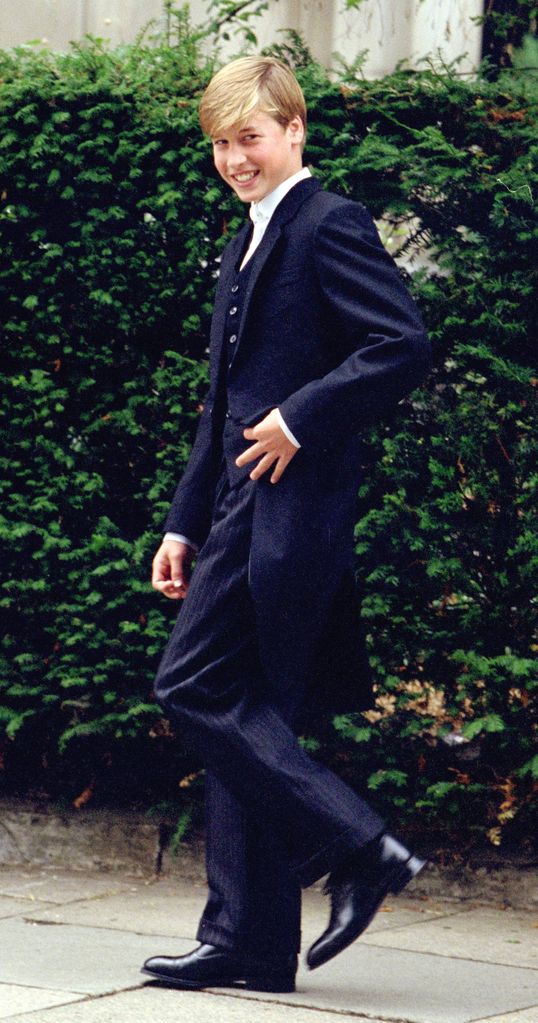 © Getty
The bigger unknown is how those around him will manage members of the public armed with smartphone cameras while he is beginning to move around more freely on his own. The Waleses’ hope is that he will be able to fit in and have some experience of feeling “ordinary” in a school where the children of high profile-families are not unusual.
As Sir Anthony Seldon previously told HELLO!: “[Eton] knows how to deal with an heir to the throne and how to provide him an environment where he will not be a talking point. He won't be a quirk. People are just very relaxed about who somebody is. You cannot put too high a value on that. What he needs is five years of life invisible to the public gaze, where he can grow up unhassled and unfussed, allowing him to prepare for a lifetime of public duty.”
William knows better than anyone what ultimately awaits George. What he and Catherine appear determined to do is give their son the time and space, long before those responsibilities reach him, to discover who he is, and what he enjoys, for himself.


