

Hailey Bieber put her glowing complexion centre stage in a new Instagram photo collection, sharing a close-up selfie that quickly attracted attention from her famous friends.
Captioned simply "september stuff", the post included a photograph of the model sitting in a car, with her brunette hair falling in loose waves around her shoulders.
Hailey wore a cream spaghetti-strap top, keeping the styling understated as daylight illuminated her face. Her beauty look featured softly defined brows, fluttery lashes and a muted rose lip, with freckles visible across her nose and cheeks.
The photograph offered a closer look at the luminous finish often described as "glass skin", with light catching the bridge of her nose and the tops of her cheeks.
 © Instagram
Hailey's famous friends react
Hailey's comments section soon filled with affectionate responses. Model Elsa Hosk wrote "Cuuuteeee" alongside a pink heart emoji, while Paris Hilton left two hearts. Natasha Poly and Hilaria Baldwin also responded with heart emojis.
The post had attracted more than 1.4 million likes at the time of the screenshot, with followers responding to her September roundup.
In the close-up, Hailey's hair was parted near the centre, with longer strands framing her face. Her neutral top and pink-toned lip colour kept the focus on her complexion, while the relaxed setting gave the photograph the feel of an everyday snapshot.
 © Instagram
How to achieve Hailey's glass-skin look
Beauty therapist Sukhee Hwang, who specialises in glass skin facials, explains that the glass-skin effect is about hydration and a smooth-looking surface. "To me, glass skin isn't about having perfect skin or getting rid of every pore. It's really about skin that looks healthy, smooth, hydrated and naturally luminous," Sukhee tells HELLO!.
"When the skin is well hydrated and the surface is smooth, it reflects light differently, so you get that fresh, almost glass-like glow."
For clients seeking that finish, Sukhee describes a staged facial programme involving three appointments over nine weeks, with treatments at the beginning, week three and week six. The remaining weeks allow time to assess how the skin responds while clients continue their home routine.
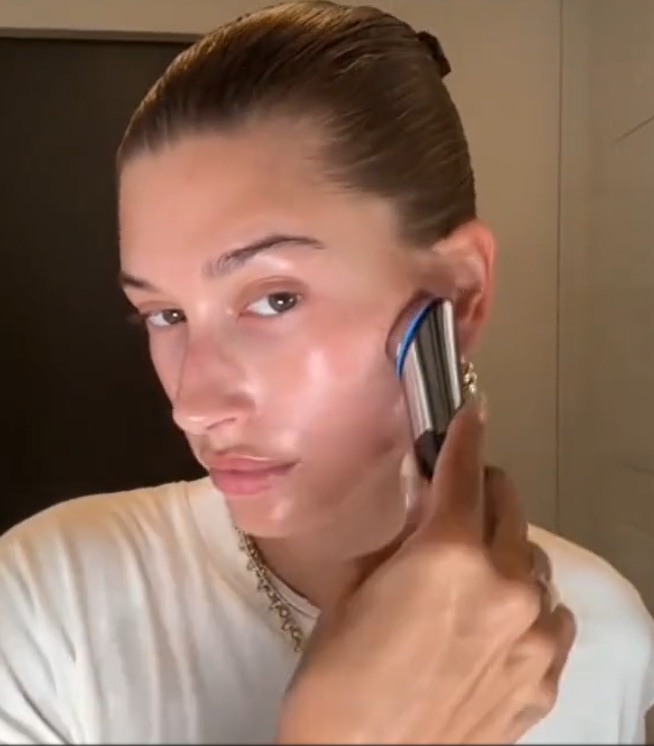 © TikTok / Hailey Bieber
The first appointment combines hydro-microdermabrasion, an exfoliating treatment, with LED light. The intention, she explains, is to begin by smoothing and hydrating the skin.
The second introduces microneedling, which uses tiny needles to create controlled punctures in the skin, followed by LED. The final appointment combines electrical muscle stimulation, or EMS, with LED, with the aim of improving the appearance of facial firmness.
Sukhee stresses that the sequence should be adapted to the individual. "Not every client necessarily needs every treatment in the same way. That's why I assess the skin before each appointment. The programme has a structure, but the skin always comes first."
 © Instagram
She also distinguishes an immediate post-facial glow from changes that might develop later. "Some of that first glow is definitely from hydration and exfoliation. After a treatment, the skin can look smoother, plumper and brighter straight away," she says. "I wouldn't promise dramatic or permanent changes from one treatment."
Nor should the combination be presented as a proven route to someone else's complexion. "The evidence is mainly around the individual treatments. There isn't one study that proves our exact three-stage programme will produce the same result for every person," she acknowledges.
Suitability and recovery matter, particularly with microneedling. Sukhee says skin can feel warm and sensitive or appear pink afterwards, and people with inflamed or highly reactive skin may need to postpone treatment and seek medical advice.
"Sometimes the best treatment is to do less," she says. Between appointments, her emphasis is on appropriate skincare, hydration and daily sun protection, rather than repeatedly adding stronger products.
"Your skin doesn't necessarily need ten different products. It needs the right products for your skin," she explains. Above all, she encourages people to judge their skin by how it feels over time, rather than comparing it with a single photograph. "A glow and healthy skin aren't always the same thing," Sukhee says. "I look at whether the skin is balanced, hydrated, comfortable and able to maintain itself between treatments. That's much more important to me than whether it looks amazing for one day."


