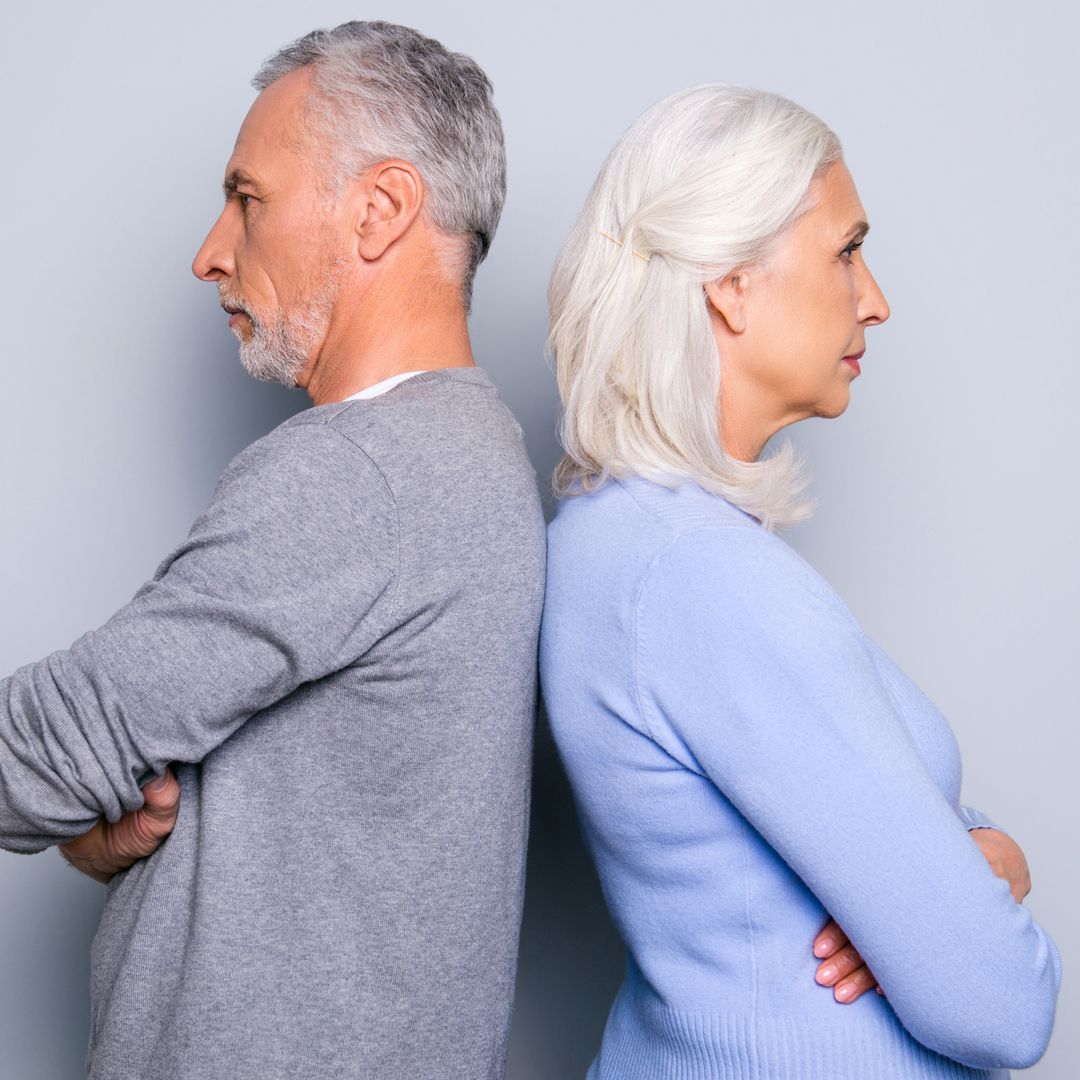
My partner and I seem to be growing apart. How do I know if my feelings of irritability and rage towards him are down to the menopause, rather than that we're no longer compatible?
If I had a penny for every time I've been asked this question, and another for each time I've fudged the answer, I'd be substantially richer and sunning myself on a Caribbean island. Menopause is a time of change, and this can apply to both our mood and our relationships. It's a bit chicken-and-egg (with fewer eggs!), so it can be a challenge to make clear judgments. I've known friends who have ended relationships during this time and lived to regret the decision when balance returns.
One study I found said that 70 per cent of menopausal women report irritability as their main mood symptom. Researchers are currently establishing a "new, female-specific irritability rating scale". Volcano to exploding supernova is the range I'd suggest!
Women are behind most divorces
More than 60 per cent of divorces are instigated by women, and this is a time of life when many relationships do come to an end. Listen to author Esther Freud on HELLO!'s Second Act podcast to hear her talk about leaving her marriage to David Morrissey during menopause...
The question is how much of this turbulence is due to hormones and how much can be attributed to a newfound sense of freedom. The average age for women to divorce is 40-44, when hormones are likely to be zipping up and down like yo-yos.
Mood swings may prompt excessive responses. I remember the rage and intolerance that marked my mid-forties, often about something as trivial as the loo roll being replaced back to front.

HELLO! has teamed up with women's health and fitness experts Move The Gap to signpost four key areas of lifestyle medicine that could help you to navigate the menopause minefield: heart health, mobility, muscle and bone strength, and cognitive health. Over the next four weeks, Move The Gap's co-founders, including personal trainer and regular guest on ITV's Lorraine, Shakira Akabusi, Owning Your Menopause author and founder Kate Rowe-Ham, former Gladiator and GB Olympian Jenny Stout, and health and mobility expert Monika Akabusi, will offer expert advice on each area – and you can sign up to receive the free and exclusive series by clicking on the button below.
Other things change, too. In addition to symptoms of menopause, this is a time of life when women develop on fast-forward, and it can be hard for both parties in a relationship to adapt. Oxytocin, the love hormone that makes us adore our tiny babies, also goes down in menopause. Many women say that they emerge from the transition more ambitious, more ruthless, less caring and – dare I say it – more masculine.
Obviously, I'm generalising about any diminishing of empathy (and believe me, if I'm fortunate enough to have grandchildren, I will not be handing them back at bath time). But it's difficult if we want different things and our partners don't.
 © Lia Toby
Communication is, I firmly believe, key to successfully navigating relationships during this time. It seems only fair to discuss what you're experiencing with your other half, though I sense that they might be aware of it! If you explain that you think you might be menopausal, you may find that they are sympathetic and, in turn, perhaps they will annoy you less. It's worth taking a deep dive inside to establish whether the irritation is directly with your partner or down to a general sense of life being out of control. It's all too easy to blame those nearest to us, when the problem might lie elsewhere.
On the bright side
I can reassure you that there are plenty of women who have emerged from menopause and found that their relationships have grown stronger. This generally happens when couples have made navigating the turbulence a joint venture.
One couple I know were at each other's throats for six years, went on a make-or-break road trip to Italy and are now the happiest pair. Others do split, and some remain close friends. I think that, with work, there is hope. And either way, I wish you both the very best.