
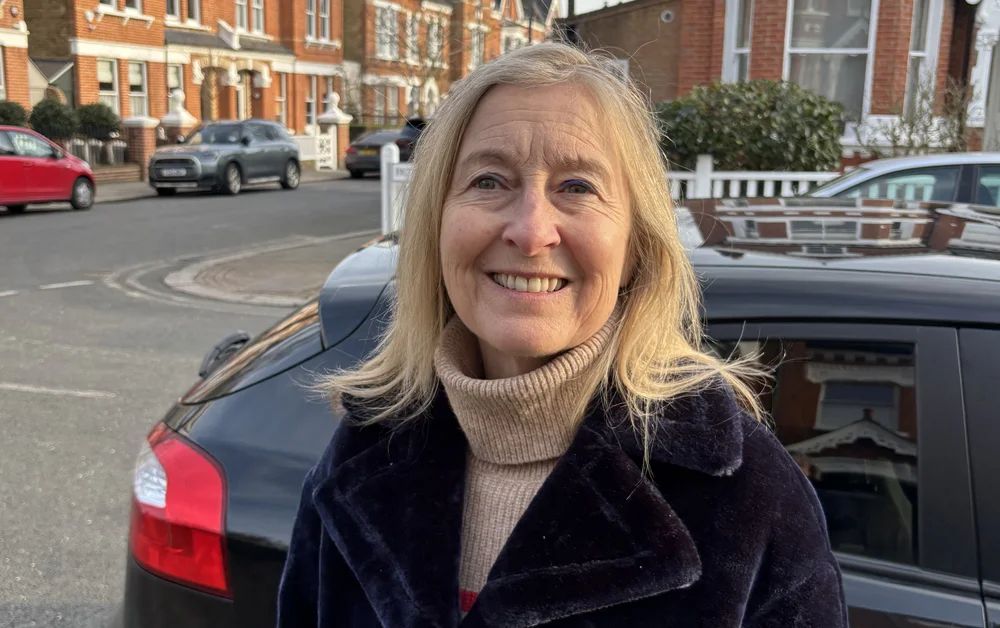
On Wednesday, ITV host Fiona Phillips' husband, Martin Frizell, took to Instagram to share a photo of his wife, who was diagnosed with Alzheimer's in 2022, aged 61.
Since then, Fiona has mainly stayed out of the limelight, so the rare photo of the beloved TV presenter delighted fans, who sent their love in the comments, with many praising the sparkle and twinkle in Fiona's eyes and her warm smile.
"It's just lovely to see Fiona's familiar smile," one fan commented, while another praised: "Darling Fiona. There's still that twinkle in your eyes and that smile that lit up our TV for many years."
Alzheimer's and appearance
Though Fiona's eyes and smile remain as recognisable as ever, it is a common symptom of Alzheimer's that those diagnosed with the disease tend to begin to look different.
An Alzheimer's support page on Facebook saw one poster ask: "Does dementia cause rapid aging in appearance?", to which many fellow users responded affirmatively. "Yes, I have seen that numerous times. I really do not understand how the person changes so quickly, but it can be frightening for those who don't see a loved one frequently," and: "Yes, my mum has aged so much in a year."
Explaining the rapid increase in ageing, a study reported that those diagnosed often have an "older-appearing face", with research suggesting that people with Alzheimer's disease may appear older than they are, due to asymmetry.
 © Pan Macmillan
Aesthetics expert Dr. Sophie Shotter explains: "Facial asymmetry often becomes more noticeable because bone resorption in the face doesn't occur evenly. The eye socket, jawline, and cheekbones can lose volume at different rates, which makes one side of the face appear subtly different from the other."
While this impacts everyone as we age, a study found that facial asymmetry was more pronounced in people with dementia (an umbrella term for a decline in memory and thinking skills, of which Alzheimer's comes under) compared to others with 'normal' cognition, with reports stating this could be related to faster brain aging as a result of the disease.
Muscle loss as we age
Though many of us may notice facial asymmetry creeping in (which can show itself as dropping and thinning of the face, including face edges, eyebrows, eyes, nostrils, and mouth), it can act as an early sign that someone is at risk of developing Alzheimer's disease. The asymmetry is a sign of muscle loss, and one study found that people with muscle loss had a 60 percent higher chance of developing Alzheimer's. This is linked to the fact that muscle loss leads to cognitive decline, which affects thinking and memory.
Changing facial expressions
People diagnosed with Alzheimer's may also look different due to reduced facial expressions, called hypomimia and sometimes referred to as facial masking. Scientists believe this could be due to a change in dopamine in the brain, resulting in less emotional feeling and expression.
 © Getty Images
The symptom is common in people with neurological conditions that affect the brain, including Parkinson's and Alzheimer's. Hypomimia presents itself as fewer facial movements and a struggle to emote, appearing emotionally flat.
A Reddit discussion of people with loved ones diagnosed with dementia saw comments confirming this, one one user writing: "My mother at some point lost the ability to express emotion with her face. When somebody smiles at you, the natural instinct is to smile back. If you smiled at her, she didn't smile." Another added: "The brain is no longer able to send signals to the face to express emotions."
Funding for Alzheimer's
Though Alzheimer's is currently without a cure, Fiona's husband hopes that the new Prime Minister, Andy Burnham, may have a heavier focus on the disease, writing on Instagram: "If the new Prime Minister, who knows what Alzheimer's can do from his father's experience, follows through on making a difference to sufferers like Fiona, his dad and millions of others, then he will become the most consequential politician of his generation."
 © Getty
Martin continued: "For decades no-one listened, dementia became the poor relation to cancer and yet it's our biggest killer. Sadly, it's taken someone touched by dementia to take it seriously but how will we afford to treat it properly? Who knows, but when your family life is altered forever by a dementia diagnosis you won't be quibbling about one or two per cent extra you’ve contributed to provide to a proper care system. If in doubt spend a day with an Alzheimer's family and you’ll see why there’s so much hope riding on Andy Burnham and Louise Casey. It cheered up our morning."


