

Michael J. Fox is letting his Parkinson's disease make decisions for him, for better or worse.
Six years ago, the Back to the Future actor, 65, decided to retire from acting, not being able to rely on his speech as consistently; he revealed his diagnosis in 1998, seven years after he was privately diagnosed in 1991.
He has however recently reversed his decision to retire, returning to the screen in Shrinking for its third season, and in fact credits the return to work for prolonging his life.
 © Getty Images
Speaking with The Hollywood Reporter, Michael, who is returning as his Shrinking character Gerry, a patient with Parkinson's disease, for season four, said that returning to acting has "really prolonged my life."
"[It has] made my life interesting in a way that I didn't think it would be to this point," he added.
"I'm not retired from acting, but if I didn't act again, it would be for a very good reason," Michael, who started acting when he was 15 years old in 1976, noted, emphasizing: "I let Parkinson's make decisions for me."
 © Instagram
Michael was diagnosed with young-onset Parkinson's shortly after wrapping work on Family Ties, which ran from 1982 to 1989, and kept the diagnosis private for the first two of the six years that he worked on Spin City, which ran from 1996 to 2002.
He ultimately went public with it in 1998, which he recalled as "hell" for wife Tracy Pollan, who he married in 1988 and with whom he shares four children. "It was really hard on her — and it still is because it's always changing."
"But I said to her, 'I have to go all the way here. No half measures,'" he further shared. "I started to understand what it was like for these people who didn't have the options or the choices I had, didn't have the connections and the reason to be optimistic. … I needed to normalize it and just be that all the time. I said, 'I have to not hide this. [Expletive] vanity.'"
 © The Hollywood Reporter via Getty
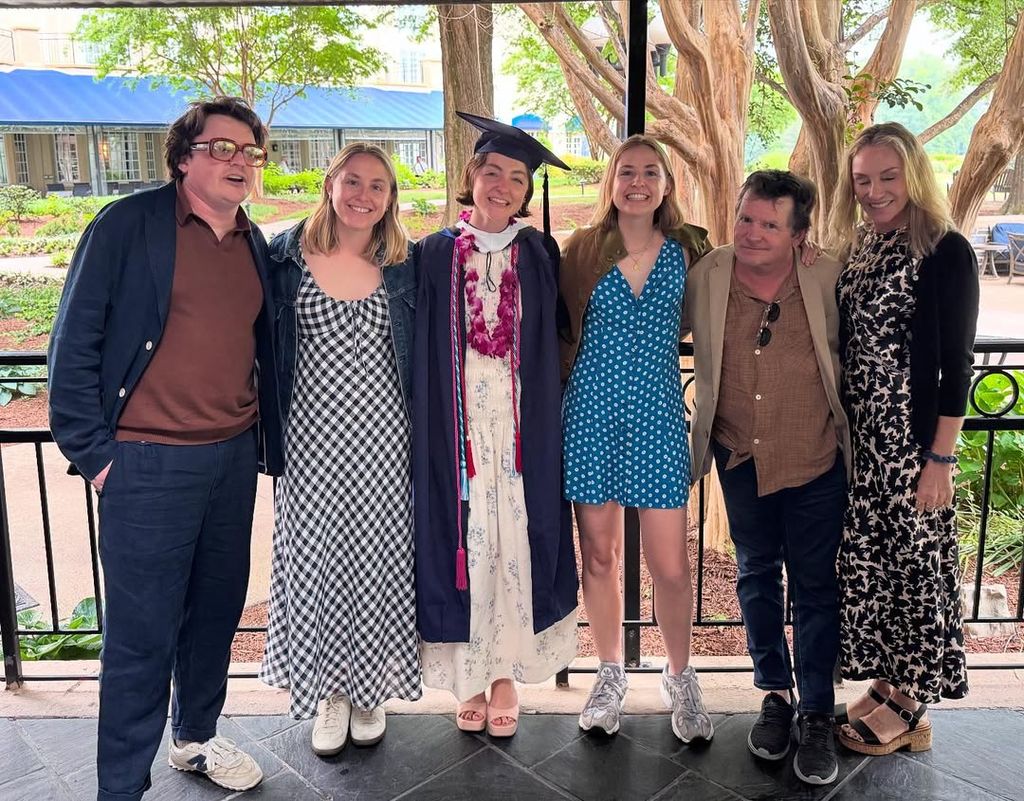
Tracy, speaking with People at the Michael J. Fox Foundation's A Funny Thing Happened on the Way to Cure Parkinson's Gala in New York City on November 2025, first noted of the family's experience with Parkinson's: "Michael was diagnosed before the girls were born and very, very early into Sam's life, so it's kind of all they know, really," and maintained: "They're just incredibly supportive."
 © Instagram
"They're very helpful to me. I lean on them a lot and [because] Michael is so optimistic, which is wonderful and really helps him, but it's really important to also understand that this is a huge challenge," she added.
"It's very difficult for the family, for the caregivers, and obviously for the patient, so I think it's also important to acknowledge that, and acknowledge that it's not just all sort of easy. It's not easy," she continued. "So you know, and it's hard for them, but they show up and you know, they're there for us."