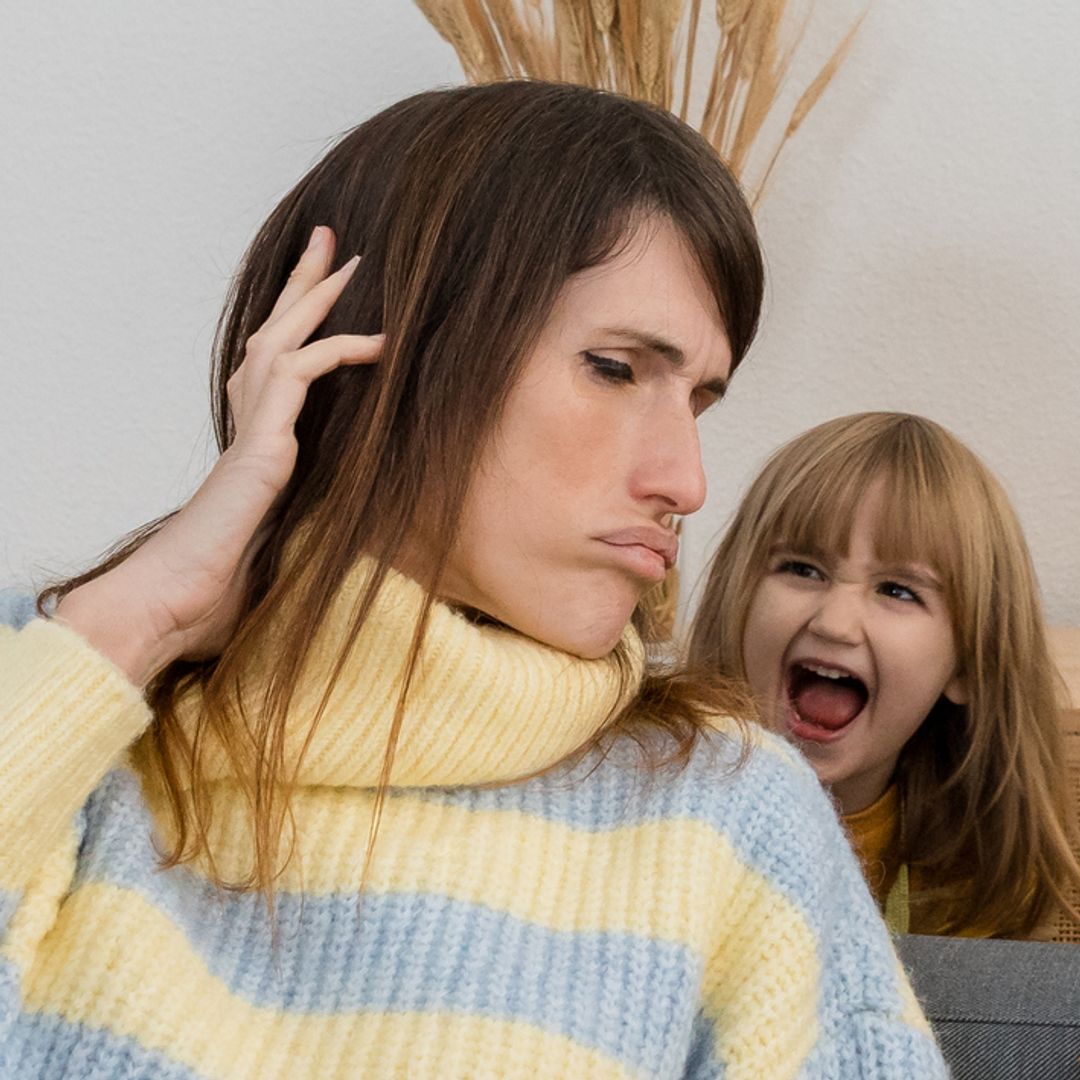

Parenting is full of highs and lows, and at times you may find yourself asking, 'Does this ever get any easier?' Many of us are prepared for the sleepless nights and round-the-clock care required for a baby, or the temper tantrums that can come hand-in-hand with the toddler years, but when the end of one challenging phase is replaced by another, it's not surprising that parents begin to feel defeated.
So, does parenting ever get any easier, and if so, when? We caught up with a psychologist to find out why raising children can at times feel such a challenge, and what you can do when times are hard.
 © Getty Images/iStockphoto
Does parenting ever get easier?
Firstly, does parenting always feel challenging, or will it get easier? According to Dr. Sharon Adusei, a licensed psychologist and Clinical Strategy Manager at Modern Health, different challenges will still arise, but you may become better at tackling them.
"Parenting may not get universally easier over time, but it becomes different at each developmental stage, and you get better at it," she says. "I often tell parents, it's like building muscle where the weights don't get lighter, but you get stronger. Research shows that parents develop what we call 'adaptive capacity', so you're literally building skills (like flexibility and emotion regulation) with every challenge you navigate and are more equipped to handle what might get thrown your way, both in parenting but also life in general."
The psychologist also shared a way for parents to shift their mindset when things feel hard. "A helpful reframe I use with parents is to switch from asking, 'Does it ever get easier?' to, 'What skills am I building now that will serve me later?' The reality is that the sleep deprivation associated with infancy is different from the emotional intensity of adolescence. However, the skills of flexibility, adaptability, emotion regulation, self-reflection, and self-compassion that you’re learning at each of those stages are entirely transferable."
Common challenges of parenting
While all families have their own issues and things that they find challenging, there are some fairly universal parenting pitfalls that most of us face - including mums who may present a picture-perfect family life on social media.
According to Dr. Adusei: "Research shows two factors tend to drain parents most: 1) the 'always on' nature with no breaks, and 2) doing it in isolation. Modern parents live far from extended family, have no built-in village for support, and navigate information overload from parenting influencers on social media telling you contradictory ways to do parenting 'the right way'.
"There are ways we’re making it even more challenging for ourselves by having access to tools that give parents a false sense of security that there is a silver bullet for their parenting challenge. Parenting influencers sell certainty in an uncertain world where the skill of coping with uncertainty is quickly atrophying. But developmental science and research on child and parent mental health doesn’t offer simple answers - it gives us principles, context, and a lot of 'it depends'."
 © Getty Images/iStockphoto
Meanwhile, you may want to reconsider which accounts you follow on social media, particularly if they make you feel inadequate or lose confidence in your own parenting as a result of the content they share.
"Research consistently shows that mothers who frequently engage with idealised 'momfluencer' content on Instagram report higher anxiety and lower confidence in parenting skills. However, effects vary such that mothers prone to social comparison are most negatively affected, while some mothers also report benefits like community support and information access," the psychologist shares.
"Other consistent challenges include the identity shift of becoming a parent, the loss of one’s sense of self, and the gap between expectations and reality. We have many cultural narratives and tropes about parenting (often perfectionistic and romanticised) that don’t align with the messy, boring, and frustrating daily reality of parenting. That misalignment, in addition to the social comparison we face to be a 'perfect' parent, especially with social media, amplifies the expectation-reality gap further."
Other factors that can make parenting feel more challenging, too, which come down to our family's personal circumstances, relationships and health, as the psychologist explains: "The primary predictor of parental stress is lack of social support. Other predictors include: financial strain, any pre-existing mental health challenges, parenting alone or in an inequitable partnership, parenting a child with more intensive needs (such as sensitive temperament, chronic health conditions, developmental differences, or neurodivergence), and cumulative stress (i.e., job loss, separation, move)."
Strategies to help when you're finding parenting hard
Thankfully, there are some simple ways to help when you're experiencing a tricky season in parenting, and while they can't always fix the issue itself, they may change the way you respond to them.
 © Getty Images
"One of the best strategies you can use when parenting is hard is to approach yourself with kindness. You can’t pour from an empty cup, and you also can’t pour from a cup you keep telling yourself isn’t good enough," the psychologist explains.
"Other strategies with the strongest research support are primarily focused on recharging so you can show up better: 1) self-compassion, 2) lowering the bar to 'good enough', 3) social connection, 4) actual reset breaks, 5) repairing relationships if needed."
But don't be hard on yourself if you find parenting hard; raising children is very much a situation where you 'learn on the job' and may become more adept at foreseeing and curbing issues before they rise over time.
"These skills often don't come naturally, and most of us are learning them for the first time as adults. That's why I encourage parents to practice these strategies before a crisis hits, when you're calm and have more fuel in the tank. The more you rehearse self-compassion, emotional regulation, and repair during easier moments, the more automatic they'll become when you're overwhelmed and actually need them," Dr Adusei recommends.
"Parents can learn these skills through self-guided content developed by licensed clinicians or by working with a coach or therapist. Whether you're building skills preventatively or seeking help during a difficult season, the evidence-based strategies are similar, and the main difference is timing and support level."
Is there a 'sweet spot' in parenting where it can feel easier?
If you're a social media user, you may have seen people sharing content about their "sweet spot" in parenting, saying that children of a particular age (often around seven to nine) are easier to look after as they are gaining independence while still young enough to need you and listen to what you say. However, Dr. Adusei says that this 'sweet spot' may not simply come down to the age of a child, but how their needs line up with a parent's personality and strengths.
"The real 'sweet spot' in parenting isn’t necessarily with a specific age range, but rather an alignment between a parent’s strengths and their child’s needs. Child psychologists call this 'goodness of fit', which means that parents who feel at ease with their parenting have a temperament style and expectations that match the child’s temperament and developmental abilities," the psychologist explains.
Some examples of 'goodness of fit' include:
- A parent who loves structure and routine might excel with the predictability of school-age kids but find toddler chaos overwhelming.
- A highly energetic parent might find a rambunctious toddler delightful but struggle with a quiet, bookish tween.
- An introverted parent might find infancy's constant physical caregiving draining, but thrive during the teen years' intellectual conversations.
"Parents may naturally find their 'sweet spot' through the concept of goodness of fit, or they can actively create one through self-awareness of their own temperament and parenting strengths, and environmental changes like building support systems."