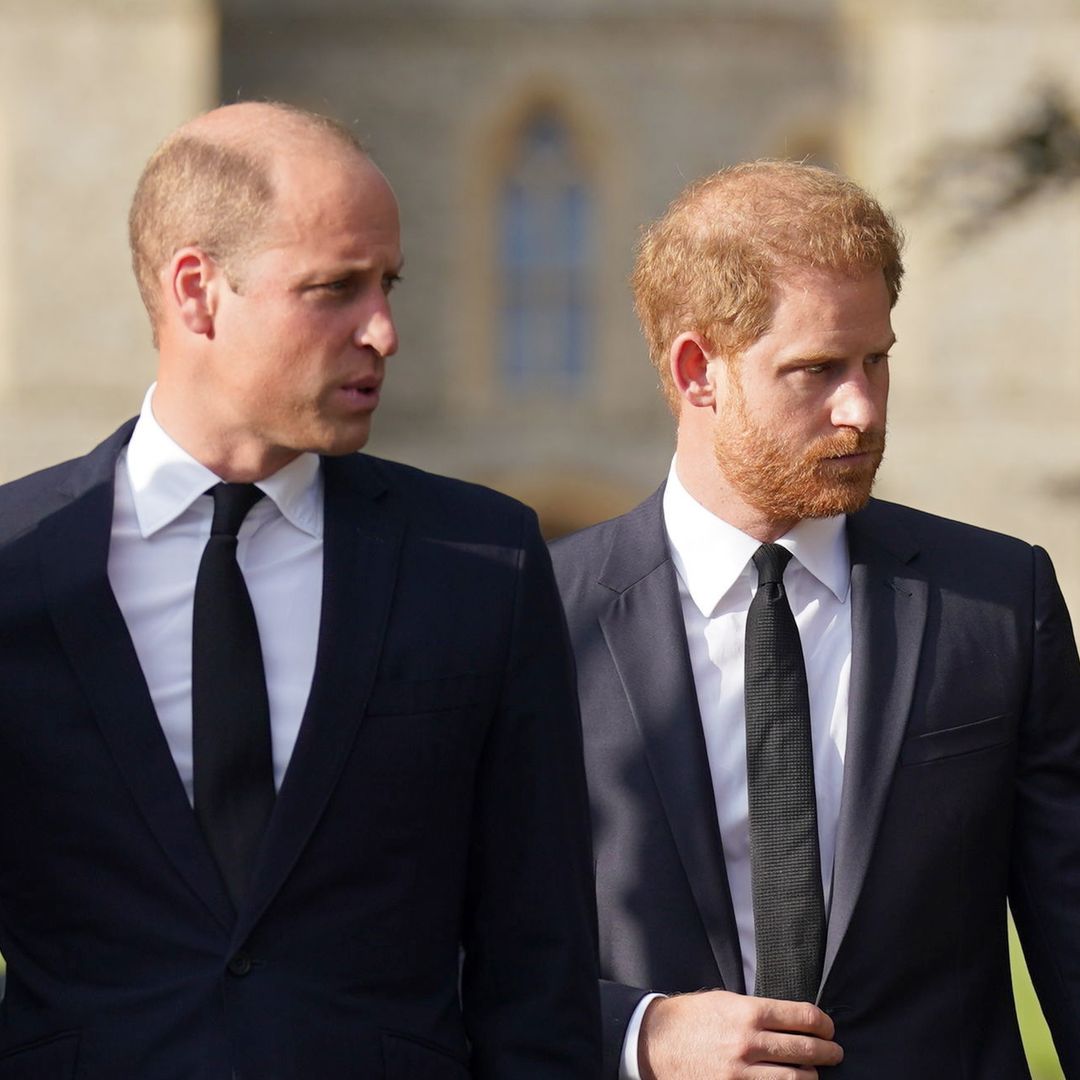
Although Prince Harry is attempting to mend fences with some members of the royal family, most notably his father, King Charles, he's still on very poor terms with his older brother, Prince William.
William and Harry's feud dates back to 2020 when Harry and his wife, Meghan Markle, stepped down as working members of the royal family. Negative emotions in their relationship came to a head when Harry released his memoir, Spare, in which he alleged that his brother attacked him following an argument about the Duchess of Sussex.
Royal feuds have turned nasty over the centuries, with some even ending with murder, and while this royal argument will not go that far, discover the brotherly battles that have defined the monarchy...
1/7
 © Getty Images
Harold Godwinson and Tostig
The reign of Harold Godwinson, last of the Anglo-Saxon kings, offers a well-known instance of sibling enmity culminating in bloodshed. Tostig was the unpopular governor of Northumbria, but rebels forced him out, and Harold convinced King Edward the Confessor to agree to their demands.
This move soured their relationship, and Harold later exiled Tostig from the kingdom. He led several failed raids against his brother, before convincing the Norwegian king, Harald Hardrada, to lead a fleet against his brother.
Harold fought in the combat, meeting his brother and the Viking, and the invaders both perished at the Battle of Stamford Bridge near York. Harold immediately marched south to face the even sterner opposition of William, Duke of Normandy, but was slain at the Battle of Hastings.
2/7
 © Getty Images
William II and Henry I
In 1100, William II, the second of William the Conqueror's three surviving sons, and known as Rufus owing to his red hair, was shot by an arrow when hunting in the New Forest.
It was perhaps a case of murder planned by his brother Henry, who became Henry I. Or, more probably, it was a case of the King's hunting companion, a nobleman called Walter Tirel, firing an arrow at a deer with fateful inaccuracy. Some historians have speculated that Henry was behind the death, with the royal seizing the Treasury and quickly getting himself crowned after William died.
3/7
 © Getty Images
Henry I and the Duke of Normandy
In 1106, Henry I defeated Robert, Duke of Normandy, his oldest brother, and imprisoned him in Cardiff Castle, where he festered for his last 29 years.
Robert had his eyes on the throne after Henry took it over, but Henry managed to win around the Court and defeated his brother at the Battle of Tinchebray after leading an invading force.
4/7
 © Getty Images
Richard I and John I
Richard I spent most of his reign abroad; when he was a leader of the Third Crusade. When Richard ended up imprisoned in an Austrian jail, John, his younger brother, attempted to replace the absent king. But while other royal feuds have ended up in murder, Richard embodied his 'Lionheart' moniker and forgave his brother.
Their feud has endured throughout history, with it partially immortalised in the Robin Hood myth.
5/7
 © Getty Images
Edward IV and Duke of Clarence
Edward didn't have the easiest time on the throne, being deposed in 1470 by his chief adviser and his own brother, Prince George, Duke of Clarence. After fleeing to Flanders, he rallied an invasion force and took back his kingdom. As an act of revenge, he imprisoned his brother, and it's thought that George was murdered there on Edward's orders.
Shakespeare twisted the event to suit his dramatic purposes: Richard III became the deed's villainous perpetrator and, to add memorable colour, the Duke was drowned in a butt of malmsey wine.
6/7
 © Getty Images
Edward VIII and George VI
In the last century, the most obvious lack of royal fraternity was between Edward VIII, who put his love for Wallis Simpson before kingship, and his younger brother Prince Albert (later George VI), who had no wish for the throne.
Edward abdicated in 1936, and was essentially exiled from the British royal family for the rest of his life, and George ruled until his death in 1952.
7/7
 © WPA Pool/Getty Images
King Charles, Andrew Mountbatten-Windsor and Prince Edward
Even the current monarch isn't above a brotherly feud, although he hasn't gone so far as to lock anyone up in the Tower of London. Although Charles and his youngest brother, the Duke of Edinburgh, are currently on great terms, when Edward founded his production company, Ardent Productions, a two-man team, who were employed by him, breached Charles' son, Prince William's privacy at the University of St Andrews, angering the then Prince of Wales.
Charles is also now distant from his brother, Andrew Mountbatten-Windsor, due to the former Duke of York's friendship with the convicted paedophile, Jeffrey Epstein. After further information about their friendship emerged, Charles stripped Andrew of his titles and exiled him from Royal Lodge.
When royal family rifts turned murderous
Fratricide, or the killing of one's sibling, was part of a wider pattern of murders generally thought to have been committed by royal relatives in the English middle ages. In 1203, King John had his teenage nephew Arthur of Brittany killed. In 1327, Isabella of France was involved in the despatch of her husband Edward II.
In 1400, Henry IV disposed of the proud and overbearing Richard II. In 1471, the tall and handsome Edward IV was behind the killing of the hapless Henry VI. In 1483, most shockingly of all, Richard III ordered, or at least considered, the murder of his nephews Edward V, 12, and Richard, ten - the so-called princes in the tower.