
I've been straightening my hair since I was 14. And I'm 36 now. For more than two decades, my hair has been subjected to hair straighteners, hairdryers, and all sorts of strategies aimed at one very specific goal: making sure it doesn't look curly.
Getting to the point where I am now, wearing my very curly hair naturally, wasn't as simple as just putting my straighteners in a drawer. It has taken time to get used to seeing myself with curly hair, to figure out what kind of cut my hair actually needs, to learn how to look after it, and, above all, to stop trying to force every single curl to sit exactly where I’ve decided it should go.
Now, I feel comfortable. I actually like it. It's helped me to like myself a bit more and to see myself in a new light. And funnily enough, ever since I stopped worrying so much about whether other people liked my hair, they haven't stopped telling me how much they love it.
So, there was a fairly obvious question I wanted to ask about natural hair from a psychological perspective: what does it actually mean to stop fighting against a physical feature we've spent half our lives trying to change?
 © Getty Images
What your choice to go natural reveals about your self-esteem
"Wearing your hair naturally can be a reflection of a shift in the relationship you have with yourself and your own image," explains psychologist Leticia Martín Enjuto.
The psychologist points out that stopping straightening or dyeing our hair doesn't automatically mean we hated it before. In my case, for example, I don't ever remember consciously thinking, "I hate my curls." I just thought I looked better with straight hair, I knew how to manage it when it was blow-dried straight, and for years that was simply my look—to the point where I'd almost forgotten what my hair was naturally like.
There's a big difference between thinking, 'I feel like wearing my hair straight today' and feeling, 'I need to have straight hair to feel okay about myself'
"Deciding to wear it as it is can mean she no longer feels the need to transform it to feel confident," notes Martín Enjuto. She adds that wearing your hair naturally can also become a real statement of authenticity. Something as simple as thinking: "This is me, and I like seeing myself this way."
 © Getty Images
The 'correction' habit: why we spend decades fighting our natural features
"Hair is a huge part of our identity," explains the psychologist. When we don't feel comfortable with it, that feeling can end up clouding our entire self-image. "Sometimes it's not our hair that changes, but the way we look at it," she reflects.
My hair certainly didn't just wake up different at 36. The curls were there when I was 14, 20 and 30. What's changed is that I no longer feel the immediate urge to get rid of them.
How beauty standards taught us to 'tame' our curls
For a very long time, we've been fed subtle (and not-so-subtle) messages about which hair is considered sleek, smart, feminine, or professional, and which hair needs to be kept under control.
"Social pressure carries far more weight than we often realise," explains Martín Enjuto. From a young age, we see certain hair types held up as the ideal, while others are presented as something to be "tamed, straightened, or fixed." And seeing that over and over again can make us believe those preferences are entirely our own.
 © Getty Images
That doesn't mean we have to demonise straighteners. Tomorrow I might fancy wearing my hair stick-straight and still feel just as good about myself. As the psychologist puts it, "There's a big difference between thinking, 'I feel like looking like this today' and feeling like, 'I need to look like this to feel okay about myself.'"
Why returning to your natural hair isn't a miracle confidence cure
Ditching the straighteners doesn't magically turn you into an empowered, completely confident woman who’s made peace with all her insecurities. If only it were that easy!
"It would be far too simplistic to look at it that way," warns the expert. We might stop straightening our hair because we've made peace with our image, yes, but also because we're just fed up with wasting time, because our tastes have evolved, or simply because it's easier.
What matters is what else is changing alongside that choice. If it comes with less self-criticism, less urge to hide away a natural feature, and a bit more ease when it comes to other people's opinions, then it really can be part of a bigger shift.
"The point isn't wearing your hair naturally; it's being able to look in the mirror and think: I can wear it however I want, because my worth doesn't depend on looking a certain way," she explains.
 © Getty Images
I haven't suddenly decided at 36 that curly hair is better than straight. I've just realised I don't have to straighten it to feel good.
The age shift: why women stop fighting their hair in their 30s and 40s
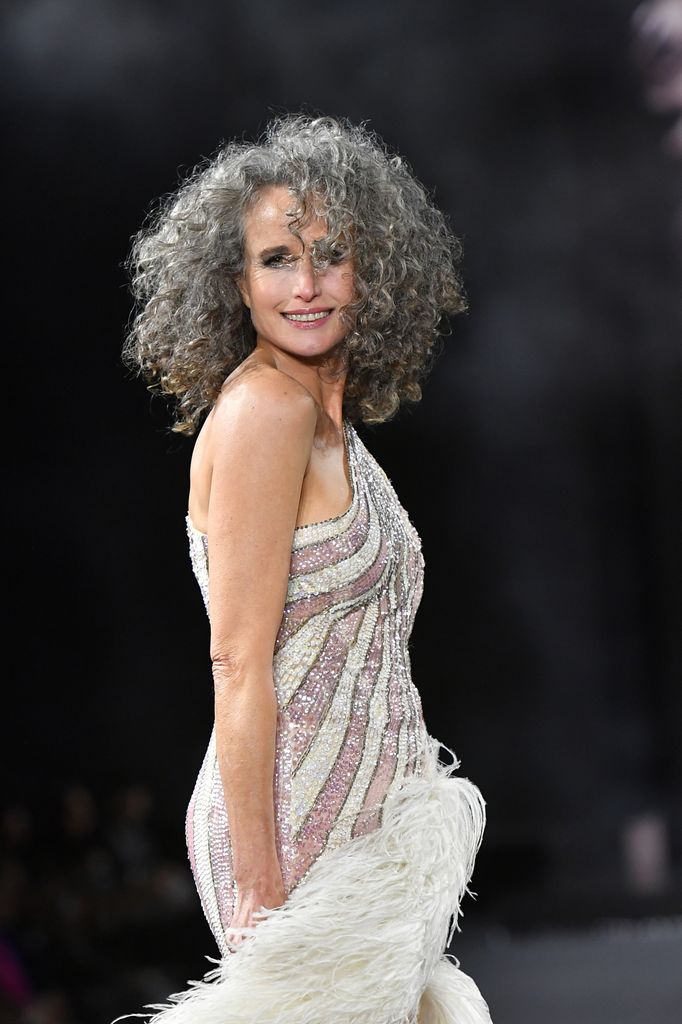
There was another part of the psychologist's explanation that really struck a chord, mainly because I know I wouldn't have made this shift in my twenties. As time goes on, we get to know ourselves better—what we actually like, what feels like us, and perhaps most importantly, we start spotting the difference between what we do because we want to, and what we do purely out of habit.
The need for external approval starts to fade, too. Not because we suddenly stop caring about our appearance (I definitely still care!), but because the person we're trying to please first and foremost changes.
 © WireImage
"There often comes a point where a woman thinks: I just don't want to spend this much energy fighting my own hair anymore," the psychologist explains. And she's spot on.
After a difficult period, stepping into a new chapter with my natural hair has ended up carrying a quiet symbolic weight that I didn't even plan for. I didn't stop straightening it thinking, "Right, I'm embarking on a journey of self-acceptance." I just gave it a go. Then came the decent haircuts, learning how to look after it, getting used to seeing myself looking different in photos, making peace with the mirror, and discovering that I actually really liked what I saw.
And then came the compliments. So many of them. "Your hair is gorgeous!" "It looks brilliant like that!" "I had no idea your hair was curly!"
It's funny, really. You spend twenty years trying to hide something, only to discover it was the very thing people loved most once you finally let it be. Perhaps, as Martín Enjuto says, accepting our hair is just "a small reflection of something much deeper: feeling more and more at home in our own skin."
About the expert:
Leticia Martín Enjuto is a General Health Psychologist and director of the Leticia Martín Enjuto Psychology Centre in Valencia, Spain.


