

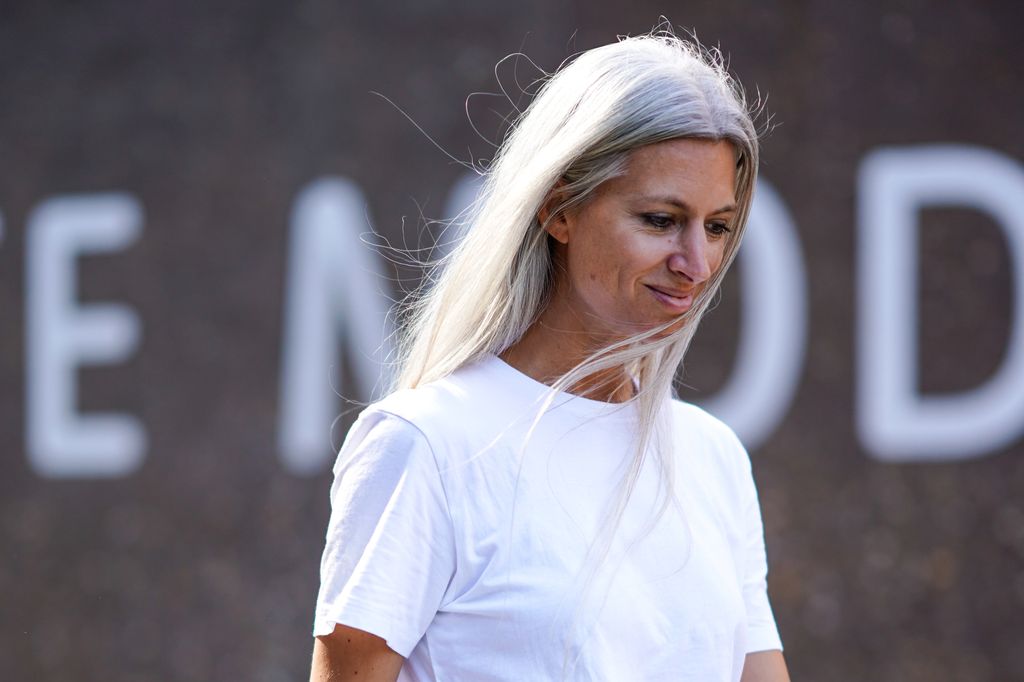
At 36, grey hairs are becoming an all-too-common occurrence. While our Head of Fashion Becky looks incredibly stylish with her full head of grey, swishy hair, the random wiry grey strands creeping in around my face are nowhere near as covetable.
So, when I started to hear rumours about haircare that 'reverses' greys, I was interested – if a little sceptical. Surely once a hair has lost its pigment (ie. what gives it colour) the only way to turn it back is to dye it? I turned to haircare experts for their take.
First things first, what causes age-related grey hair?
 © Getty Images
"Hair gets its colour from melanin, which is produced by pigment cells called melanocytes sitting in the hair follicle," explains consultant dermatologist Dr. Aamna Adel, who is founder of haircare brand rhute. She elaborates that when those cells get tired, they stop producing pigment, resulting in greying strands.
"Once the follicle is no longer adding pigment, the hair grows through without colour, and what we perceive as grey or white is really hair with little to no melanin. It's a gradual, natural process that happens strand by strand, which is why greying comes in over years rather than all at once."
Caring for our follicles
Knowing this, I'm beginning to understand how caring for our follicles could stave off grey hair, which Dr. Aamna confirms.
"Preventing or delaying new greys is biologically conceivable, in the sense that protecting the follicle from oxidative stress and looking after your overall health may help support pigment cells for as long as possible."
But even then, nurturing our follicles is tricky, and hair care that promises to do that might not live up to expectations.
 © Edward Berthelot, Getty
"There's no long-standing evidence that topical treatments work. For a topical to influence pigment at all, it would need to penetrate right down to the living part of the follicle and meaningfully reactivate cells that have already wound down, which is a high bar."
She concludes: "Some antioxidant ingredients are theoretically interesting for supporting the follicular environment, but supporting the environment is very different from restoring lost pigment."
Even in this instance, looking after the follicles to prevent losing pigment is different to restoring pigment to hair that has lost it.
 © Instagram
So, can you reverse grey hairs?
If it's age-related greying, it seems unlikely.
"Re-pigmenting hair that has already gone grey can be difficult, because it usually means the pigment cells are already depleted, and reactivating them is something we can't reliably do."
She confirms that any "credible effort" to maintain our original hair colour is more about protection and delay than about bringing colour back to hair that's already white.
That said, there may be some scope to reverse greying when it's driven by a specific, treatable trigger such as stress or a nutritional deficiency, but for the general age-related greying most people are asking about, there isn't much scientific evidence to back up claims of reversing grey hair.
If your hair has greyed due to stress, Dr. Aamna reports that there's "fascinating" research showing that greying linked specifically to acute stress can sometimes reverse when the stress resolves.

The science behind reversing grey hair
Growing hair is an energy-hungry process. Mitochondria - tiny 'power stations' inside our cells - supply the energy needed to build each strand.
As hair grows, it is also exposed to signals from the body, including stress hormones. And it turns out those signals may leave a mark. In a study into human hair greying and reversal, researchers found that when one person's stress increased, their hair lost pigment.
When their stress eased, the same hair regained its colour. Grey hairs also contained more proteins linked to mitochondria and energy production, suggesting a possible connection between stress, cellular energy and greying.
In other words, grey hair may not always be a one-way journey.
When stress rises, it may disrupt the processes that keep hair pigmented - and when it falls, some of those processes may switch back on.
"This tells us the process isn't always a permanent one-way street. But that's quite different from reversing the established, age-related greying that most people are asking about, and there's no proven treatment that reliably re-pigments hair at this stage.
How to care for your follicles in two easy steps
1. Scalp care
Looking after the scalp with consistent, gentle care to support the environment hair grows from can't hurt.
I've been using Sisley's Super Serum, £200, which, despite Dr. Aamna's stance that it's hard to reach deep down far enough, consistently enough to help the follicles, was created to support the energy in the follicle bulb to protect the hair's natural colour.
I can't report fewer greys yet, but it's a pleasure to use (not greasy, makes my hair feel silky), and trials report 91% satisfaction in its ability to slow the appearance of grey hair.
Dr. Aamna favours her own brand's Density + Repair Scalp Serum, £55, to support the scalp barrier while helping reduce shedding and support density
2. A hair-friendly diet
According to Harley Street Hair Clinic, your diet can "make or break" in regard to grey hair.
"We see patients with premature greying all the time, and all of them have low iron, copper, and vitamin D levels. Simple diet changes can help you avoid the constant cycle of dyeing. If you're spotting greys in your 20s or 30s, look at your nutrition first before you reach for the box dye."
They recommend adding lentils for iron to support melanin, salmon for vitamin D to support the hair growth cycle and sunflower seeds for zinc to support follicle repair.


