
Are you the type of person who thanks drivers in cars for stopping so you can cross the road? Your everyday conduct when out and about can say a lot about your personality, according to psychologists.
And although we are all unique, with our own strengths and weaknesses, likes and dislikes, experts believe that we all share five key personality traits. However, it is where we sit on the spectrum of each trait that makes us different. Fascinating, right? To learn more, we caught up with Jennifer C. Veilleux, a clinical psychologist and Professor at the University of Arkansas, Fayetteville.
 © Getty Images/iStockphoto
What are the big five personality traits?
The professor, who teaches courses on personality and personality assessment, is keen to distinguish the difference between personality traits and personality types. "One thing that I think is important right off the bat is that science does not support the idea of personality 'types.' Human beings love types - we love to think about what Hogwarts house we are in, or whether we are an 'enthusiast' or an 'achiever' (note: these are Enneagram types)," Jennifer says.
"However, the science is crystal clear on this: human beings do not fall neatly into boxes, and therefore shouldn't be explained by types. The personality 'type' stuff (including Myers-Briggs, enneagram, etc.) is pseudoscience, not personality science."
Instead, the Big Five Personality Traits have been established. "These are traits that across countries, cultures, ages, and time have popped up repeatedly as the best five dimensions to describe people. The crucial word here is 'dimensions' - each of the Big Five is a dimension," the clinical psychologist explains.
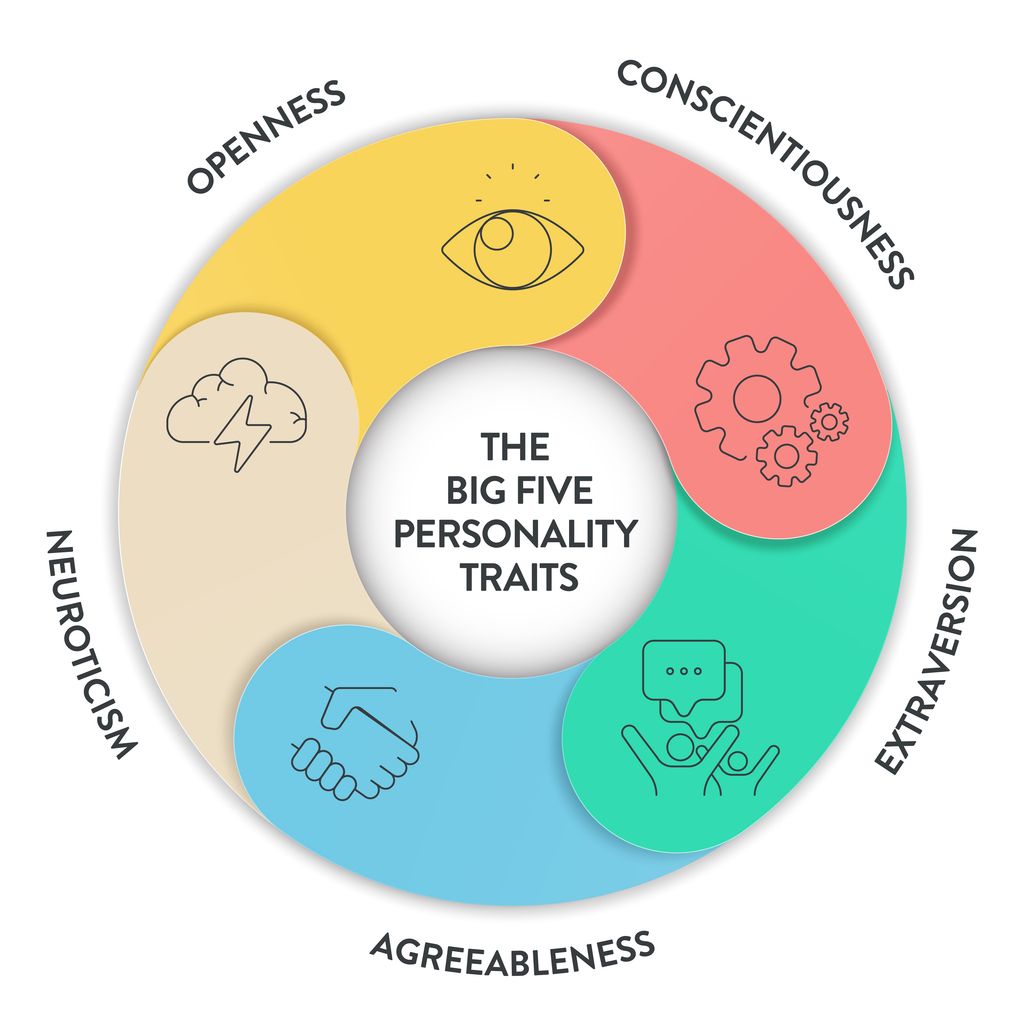
The Big Five together can be best remembered by the acronym of OCEAN:
- Openness to experience
- Conscientiousness
- Extraversion
- Agreeableness
- Neuroticism
"On each of these traits, people can be very low to very high, with the majority of people who tend to fall in the middle," she said.
 © Getty Images
Openness to Experience:
"This is about seeking novelty, liking beauty, art, books, and appreciating learning for the sake of learning. High openness tends to correspond with more liberal political attitudes too, whereas low openness people tend to prefer sameness, tradition, and are less intellectually inclined."
Conscientiousness:
"This is about organisation, punctuality, and rule-following. People who are high on conscientiousness are planners and i-dotters, detail-oriented and able to juggle all the balls in the air (metaphorically). Those very low in conscientiousness tend to be disinhibited, more spontaneous, and can be lacking in self-control or consideration of others."
Extraversion:
"This trait is about the tendency to want to be socially engaged. Those high in extraversion like to be around people, are the folks who chat people up in elevators, and who are often good leaders. Those very low in extraversion are more introverted, preferring one-on-one or small groups to large crowds, who tend to be shy and find their energy drained from social events."
 © Getty Images
Agreeableness:
"Agreeableness is about getting along with people. Those who are very high in agreeableness may be passive and struggle to stand up for themselves, but they are also the peace-makers who, although conflict-averse, are the individuals who bring people together. Those who are very low in agreeableness are antagonistic, not caring what others think of them or who is getting along."
Neuroticism:
"Finally, neuroticism is about low emotional stability. People who are high in neuroticism are easily stressed, tend to feel more intense unpleasant emotions and have more ups and downs in their feelings. Those who are low in neuroticism tend to be more even-keeled, may not be in touch with their feelings, and generally experience little emotional fluctuations (especially for the unpleasant emotions)."
Which personality traits do you have if you say 'thank you' to cars while crossing the road
So, what does it say about your personality if you stop to thank cars when you cross the road? According to Jennifer, it shows a sign of strength in two key personality traits. "I would imagine that a pedestrian who thanks cars when crossing the road tends to be higher in both agreeableness and conscientiousness, especially conscientiousness," the clinical psychologist explains.
"Showing appreciation to a car for slowing down and stopping means the car (and the pedestrian) are following the rules of the road and the unspoken rules of common decency. Those who are high in conscientiousness are attentive to rules, and those who are agreeable tend to thank others for their efforts and show appreciation to other people."