

You've heard of the 'terrible twos', right? Well, sorry to burst that bubble, but tantrums start around one – with an almost two-year-old, I can vouch for that! Apparently, this era can last until three or four (eek), but we've enlisted Parenting Coach from Positively Parenthood, Heidi Skudder, to share her wisdom about curbing toddler tantrums.
Heidi is set to impart her knowledge at The Baby Show, which returns to Olympia London from 24 - 26 October, helping lots of parents out, and she's put together her ultimate tips for managing your little one's big feelings, including what you're probably doing wrong…
 © Getty Images
Heidi has an interesting take on tantrums – they aren't a bad thing! "The reality is, there is nothing terrible at all about toddler tantrums and by responding to them in the right way, you can help shape your toddler's brain for the better."
She explains: "Toddler tantrums are also referred to as big feelings. We all experience emotions; the difference is that small children really struggle to be able to contain those emotions, and instead, they just let them all out. As adults, we have impulse control, which is the brain's ability to think something but not necessarily act on it."
How to deal with tantrums
1. Understand the why
"As mentioned, toddler tantrums are linked to brain development. Neuroscience tells us that the prefrontal cortex which is responsible for impulse control, does not develop until our early 20s. This means that big feelings and meltdowns are going to be a key feature during childhood. Know that this is normal and not something your child is doing on purpose."
 © Getty Images
2. Track patterns and learn triggers
"Most toddlers will find life more difficult when they are hungry, tired, or overstimulated. Whilst we can't stop them melting down entirely, we can choose to have quieter times, feed them earlier or keep things calmer to help avoid such huge meltdowns."
3. Never 'give in' to a tantrum
"Whilst they are difficult, giving in is not the answer. You can still stay close to your child and comfort them, whilst sticking with your boundary, e.g, 'We are not having that snack now'."
As a toddler mum myself, I can agree that sticking to your guns has been beneficial. I know parenting techniques are a lot softer these days, but I do think children respect boundaries. We've found that when we've stayed firm on things, even when our son is having the biggest meltdown, it's paid off in the future. He once refused to say, 'Please' for a yoghurt after dinner, even though he usually does. We let him cry until he said it, and now he's always so polite!
4. Keep them safe
"Due to their lack of impulse control, throwing things and lashing out is really normal. Make sure your toddler is somewhere safe, especially if they are throwing themselves on the floor."
 © Getty Images
5. Give them a little space
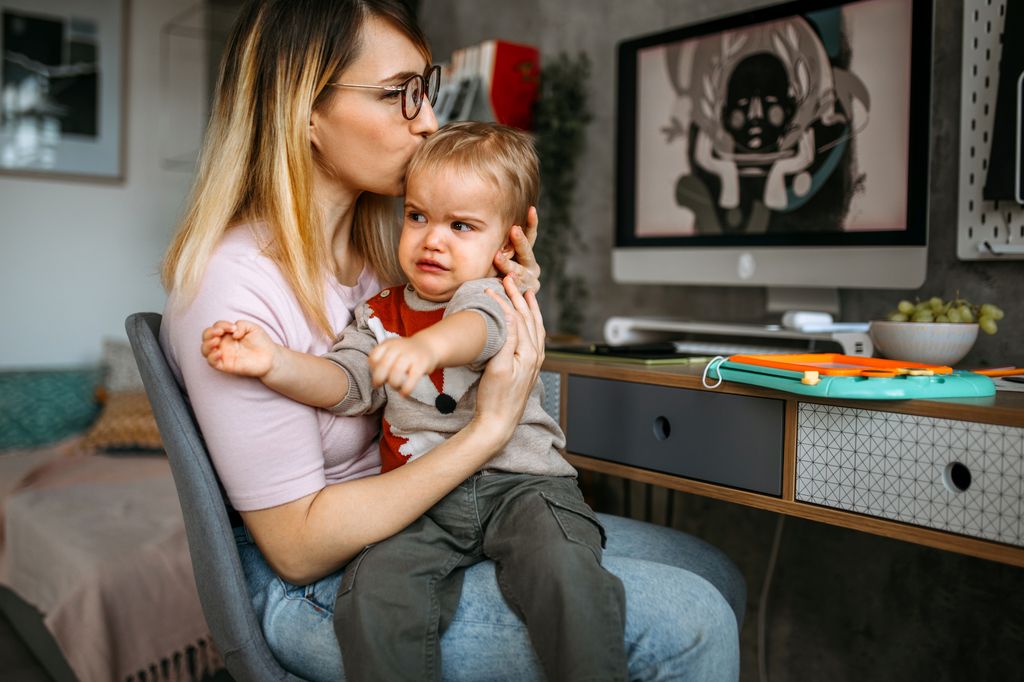
"Whilst they are feeling all the big feels, it is unlikely that you can rationalise with them, and trying to do so can make things worse; therefore, the best thing to do is step back but stay close, ensure they are safe and let them know that you are there for a hug when they are ready."
I'll be honest, this is what I really struggle with. I want to reason with my son and say, 'If you put your shoes on quicker, the sooner we'll be outside,' for example. But it just doesn't get through, so I've found distraction is my best tool. Asking random things like, 'What colour are your shoes?' and 'How many shoes are there?' to coax him to put them on.
 © Getty Images
6. Start learning to name emotions
As your toddler moves towards pre-school and school age, they will be able to start labelling their emotions. You can do this with a small toddler from the very word go. 'I can see that you are really angry right now', or 'You are really upset about this', helps give them the vocab they need to become emotionally in tune as they grow up."
7. Be the calm they need
"And finally, remember that all emotions are valid and not to be squashed down. It might feel triggering, and your reaction (from your own childhood) might be that they are just being 'naughty' or doing it 'on purpose', but really big feelings and meltdown come from needs that they have and are totally valid. You don't have to agree, but you can create the calm they need to come out the other side sooner."