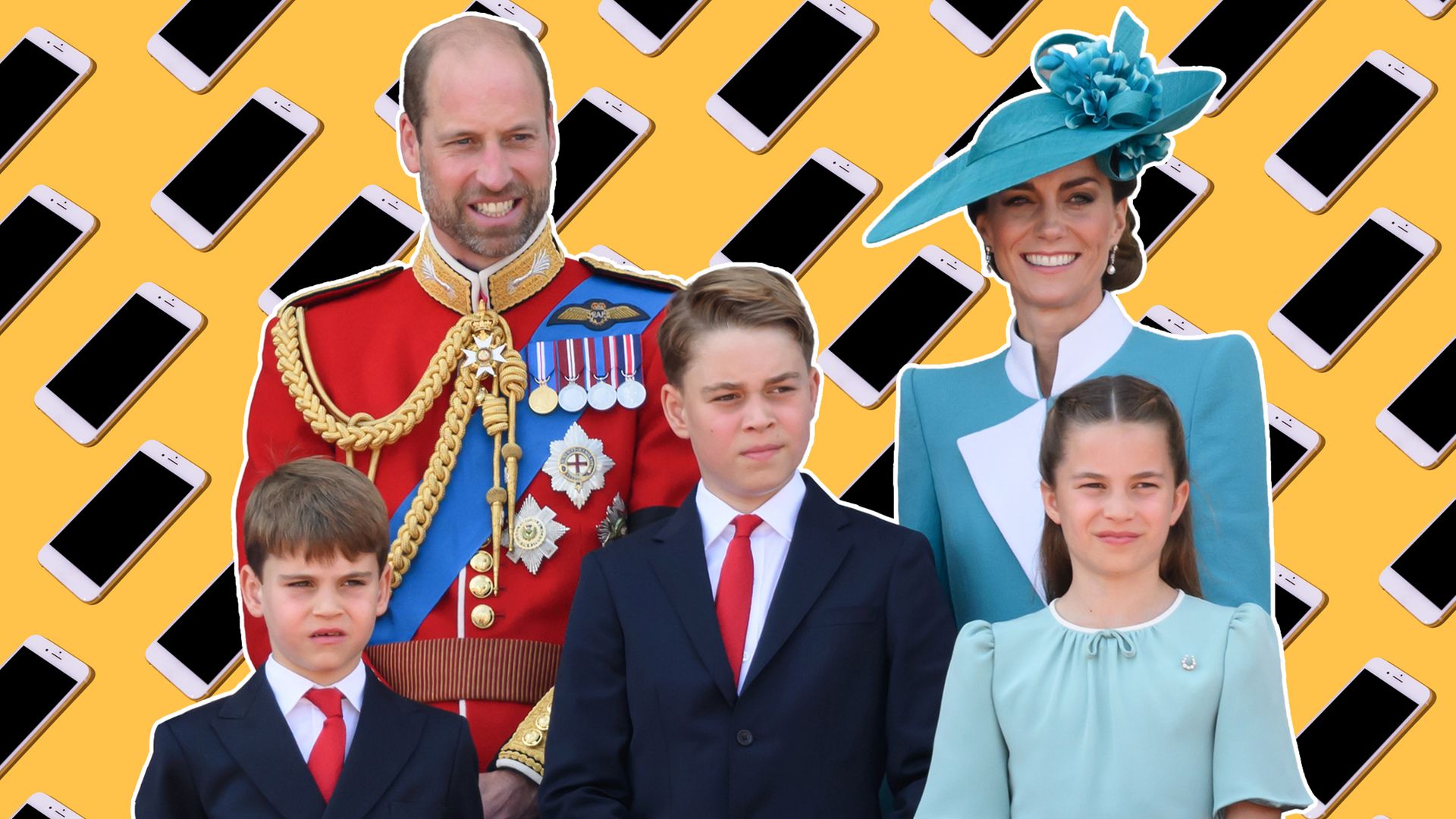
The Prince and Princess of Wales may be modern royals, but that doesn't mean their children have the latest mobile devices. Far from it. The royal parents of three have chosen to keep their kids, Prince George, 12, Princess Charlotte, ten, and Prince Louis, seven, phone-free.
While filming an episode of Apple TV’s The Reluctant Traveler in February 2025, Prince William revealed to Emmy winner Eugene Levy that none of his kids "have any phones," adding that he and Catherine are "very strict about" that.
Though some could perceive the Waleses' choice as old-fashioned, Jo Frost, a global parenting expert and childcare specialist, calls it a "modern, mindful parenting decision".
"From a professional standpoint I strongly agree with the decision the Prince and Princess of Wales are making. Their approach to holding back on smartphones and limiting their children's screen exposure is not old-fashioned parenting – it is based on informed, intentional and deeply connected, intuitive parenting," Jo, who has previously penned The Prince & Princess of Wales Are Truly Dynamic Duo Parents, tells HELLO!.
"I see on social media this blanket tone as if old-fashioned often implies nostalgia, a longing for the past, or a resistance to progress. This is none of those things."
"These parents are fully aware they are raising children in a digitally saturated world just like millions of other parents worldwide. They are not in denial of technology's place in society and they are simply choosing to lead rather than react and cave in," Jo adds.
"They have made their decision centered solely around their children and not themselves. What we are seeing as the public is a modern, mindful parenting decision made based on what we now know about child development, emotional regulation, attention, sleep and connection."
The Princess of Wales herself has pointed out that while devices can connect us, they "frequently do the opposite". In an essay titled The Power of Human Connection in a Distracted World, authored by Catherine, in collaboration with Professor Robert Waldinger, the Princess wrote about the "complex and often troubling" role technology plays in the "epidemic of disconnection."
The Princess penned: "Our smartphones, tablets, and computers have become sources of constant distraction, fragmenting our focus and preventing us from giving others the undivided attention that relationships require. We sit together in the same room while our minds are scattered across dozens of apps, notifications, and feeds. We’re physically present but mentally absent, unable to fully engage with the people right in front of us."
The benefits of delaying mobile phone ownership
Jo notes that research continues to show that premature or too much access to "personal devices can interfere with a child's ability to build secure relationships, tolerate boredom, develop focus, and learn social nuance".
"When parents delay phones, they are not withholding, they are protecting, and that has to start from birth. It is deeply concerning seeing young babies with phones in their hands. We have a public health crisis for our young baby and toddler minds and the Princess of Wales knows this all too well because of all the wonderful work being done with her Royal Foundation for children," Jo says.
"Protecting childhood is not regression. It is parental leadership at this stage in our modern world."
The parenting expert continues: "By prioritising conversation, presence, preserving outdoor play, imagination and real-world relationships, these parents are strengthening the very skills their children will need to navigate the future: empathy, confidence, resilience and self-worth that is not dependent on a screen or external validation."
Royal children and phones
Although the Waleses have avoided giving George a phone, William has said that his eldest might get one this year when he begins at his new school. "Our children don't have phones. I think when George moves on to secondary school, then maybe he might have a phone that has no internet access," the Prince of Wales shared with Brazilian TV host Luciano Huck in November 2025. William revealed at the time that it was "getting to the point where it's becoming a little bit of a tense issue," but thinks his son George "understands why".
"We communicate why we don’t think it's right," William said. "And again, I think it's the internet access I have a problem with. I think children can access too much stuff they don't need to see online, and so having a phone and text message, the old sort of 'brick phone' as they call them."
One member of the British royal family confessed last year to being persuaded into buying a phone for one of their kids. Sophie Winkleman, the daughter-in-law of Queen Elizabeth's cousin Prince Michael of Kent, revealed to The Sunday Times that she gave her daughter Maud a phone after the 12-year-old expressed that she was feeling isolated at school.
"Many parents say they feel the pressure... 'Everyone else has one,' 'I don’t want my child left out,' 'This is just how the world is now.' Yet more and more parents are quietly asking: 'Is earlier really better?' Or is it just too noisy? Choosing to wait is not being led by fear," Jo tells HELLO!. "It's about discernment. When you know more, you do better. When parents understand the long-term impact of technology on developing brains, nervous systems and relationships, pausing becomes a powerful act of care."
"I want families to understand this is not about rejecting the future, it's about preparing children to enter it grounded, connected and secure, finding the middle ground and parenting from there," Jo continues. "That, in any generation, is wise parenting."