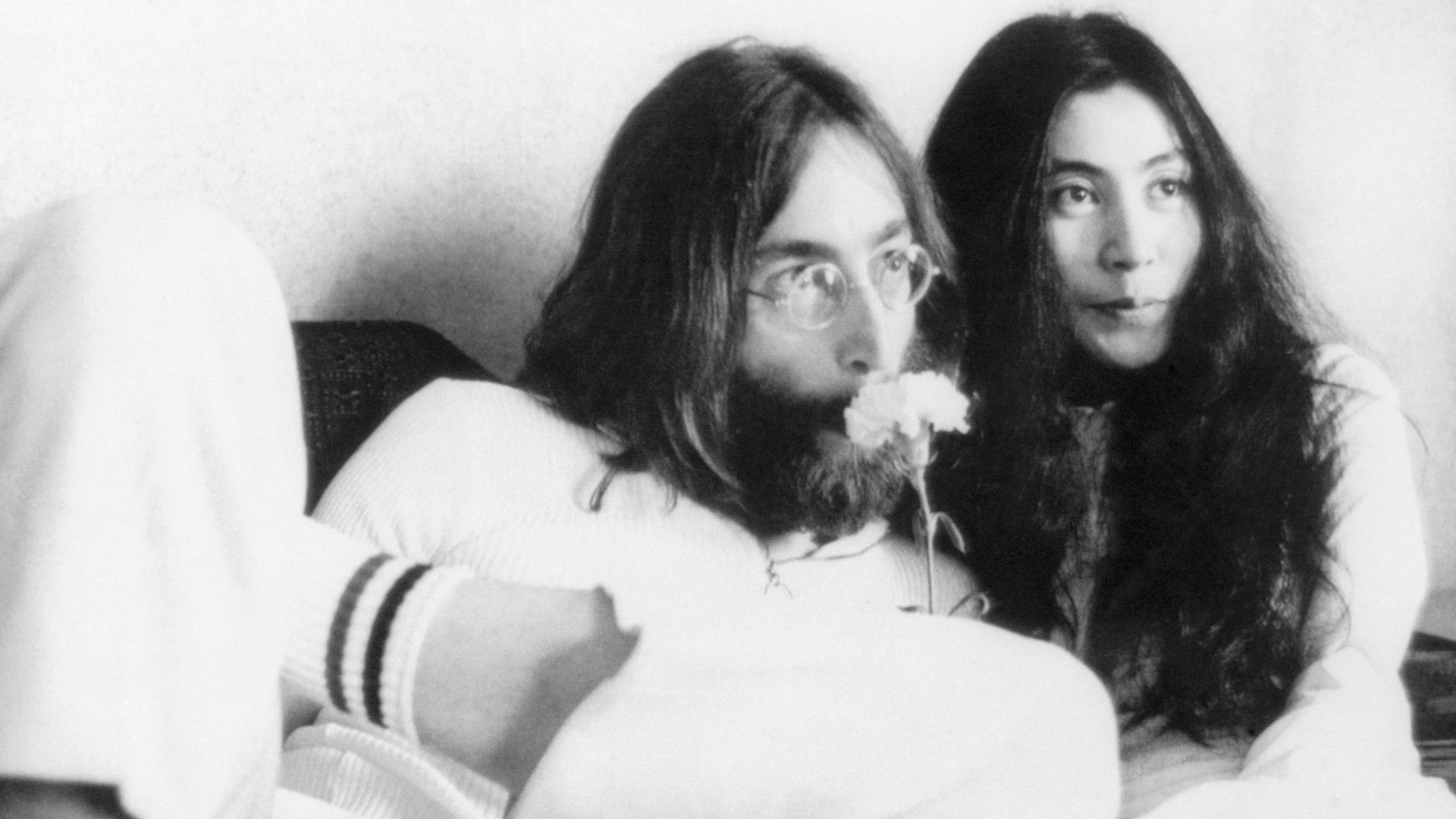
Few relationships have captured global media attention like that of The Beatles co-leader John Lennon and his unconventional relationship with performance artist and musician Yoko Ono. Together, the pair embarked on a radical romance that fused avant-garde artistry with passionate activism, until John’s untimely death in 1980.
On what would’ve been his 85th birthday, we’re taking a look back at the couple’s legacy in photos, from stepping out together at the Yellow Submarine premiere to recording their final album shortly before John’s death.
Yoko, John, and Paul at the world premiere of "Yellow Submarine" in Piccadilly Circus, London, 1968
Yellow Submarine premiere (1968)
John first met Yoko at her solo art exhibition at the Indica Gallery in London, and was immediately infatuated by both her and her work. While it’s disputed when they began their affair, the star left his first wife Cynthia Lennon in 1968, the same year the pair went public.
Cynthia revealed her suspicions about her husband’s infatuation with the artist in a 1985 interview with Fresh Air, saying her “feminine intuition” told her something was happening between the pair. “I knew there was not a thing I could do about it…there was no way I could’ve stopped him”.
Yoko accompanied John to the premiere of Yellow Submarine in July 1968, The Beatles’ animated jukebox film, posing with Paul McCartney amid rumours of tension between the two. Paul had reportedly been uncomfortable with Yoko’s presence at the recording of The White Album, the band’s ninth studio album, breaking an “unspoken rule” about partners in the workplace and later describing her being there as “an interference”.
The censored version of "Two Virgins", the controversial first album by John and Yoko
First album (1968)
John and Yoko shocked the world with the release of their first album together, Two Virgins. It featured the pair completely nude on the front and back, a move considered totally unprecedented for a mainstream artist of John’s fame. The music was also a big departure from John’s sound with The Beatles – it was an experimental collection of tape loops, noise, and abstract vocalisations.
The album was recorded in May 1968, when John was still married to Cynthia. His wife had gone on a holiday with friends, and returned to find John and Yoko together in bathrobes, effectively ending the couple’s six-year marriage.
The other Beatles were rumoured to be too thrilled about the negative buzz the album was generating, with Paul reluctantly supplying what many think is a sarcastic blurb for the album’s cover: “When two great Saints meet, it is a humbling experience”.
The media didn't find out about John and Yoko's wedding until after it happened
Wedding (1969)
John and Yoko tied the knot in March 1969 at a highly private ceremony in Gibraltar. Unlike John’s wedding to Cynthia, not even his Beatles bandmates were invited – there were no personal guests aside from Anthony Fawcett, the pair’s personal assistant.
The couple had tried to get married in Paris, but were blocked by visa and residency restrictions, leading them to choose Gibraltar, a British territory that allowed them not only to marry quickly, but away from prying eyes. The wedding lasted just 10 minutes at the British Consulate, and John later described the couple’s ordeal in the Beatles track “The Ballad of John and Yoko”, singing “You can make it okay / You can get married in Gibraltar near Spain”.
You may also like
The couple during a "Bed-In for Peace" at the Hilton Hotel, Amsterdam, 1969
Bed-In for Peace (1969)
Both ardent anti-war believers, the couple began to hold “Bed-Ins for Peace” in 1969, where they stayed in bed for a week and invited the media to their hotel room to discuss peace. During their protest in Montreal, the pair recorded “Give Peace a Chance”, which became the anthem for the anti-Vietnam War movement.
John and Yoko also launched their infamous “War Is Over!” campaign the same year, encouraging people to protest political violence, and splashing the bold slogan on posters and billboards worldwide. The iconic track “Happy Xmas (War Is Over)” became an enduring Christmas classic and a timeless call for peace.
While some considered the couple’s protesting self-indulgent, they continued to attract attention to the cause – especially when they started growing their hair out. “Everybody should do it, all over the world – if only to bring about more awareness,” John told reporter Rick Wilson during a Bed-In in Amsterdam. “But we’re doing it with a sense of humour, too, because we think the world needs to laugh more.”
Julian, John, Yoko, and Kyoko in 1971, shortly before Yoko's ex-husband gained custody
Family life (1971)
After marrying in 1969, Yoko became the stepmother to John’s son with his former wife, Julian, who was five-years-old when the couple divorced. Paul had reportedly penned the song “Hey Jude” to comfort the boy during John and Cynthia’s highly publicised divorce, and the public were curious what Julian’s dynamic would be with John’s new wife.
Similarly, Yoko had a daughter, Kyoko Chan Cox, from her previous marriage to filmmaker Anthony Cox. The exes began a bitter custody battle over Kyoko in 1971, which ended with Anthony winning temporary custody and then fleeing with his daughter to a Christian fundamentalist group, deeply upsetting John and Yoko, who searched for her for years.
Rumours swirled that Julian and Yoko did not get along, exacerbated by Julian’s strained relationship with John. “Dad was a hypocrite,” Julian Lennon later told The Telegraph in 1998. He could talk about peace and love to the world but he could never show it to his wife and son”.
The couple settled in America, pictured here in matching outfits in 1973
Leaving England (1971)
The couple decided to leave England for New York in 1971, which John saw as a place to break away from The Beatles’ shadow after leaving the group several years prior. New York City, with its vibrant art and activist scenes, felt like a better place for the couple to begin anew, and escape hounding from the UK press.
The pair became increasingly involved in more anti-war activism after the move, with John releasing the infamous “Imagine” in 1971. The Nixon administration began efforts to deport John due to his political activities, based on a 1968 cannabis conviction in the UK, a court case John ended up winning.
After the release of their joint album Some Time In New York City, John entered an 18-month period in 1973 known as the “Lost Weekend”, where he separated from Yoko and had a relationship with May Pang, his assistant. The pair later reconciled in 1975, and their only son together, Sean Oko Lennon, was born the same year.
David Bowie, Yoko, and John at the 17th Annual Grammy Awards in 1975
Grammys Awards (1975)
The later half of the ‘70s was a more private period for the couple, often called John’s “househusband” years. The star stepped away from music to focus on raising Sean, while Yoko managed the pair’s finances and business interests.
The Grammy Awards in 1975 were the first public appearance for the pair since they got together again, with John presenting the Record of the Year award with Paul Simon. He also gave a famously candid interview with the BBC, reflecting on the possibility of a Beatles reunion: “If we wanted to do it then it would be worth it… the music is the music and if we make a piece that we think would be worthwhile, then it goes out”.
The album cover for "Double Fantasy", released in November 1980
Return to music (1980)
After a sailing trip to Bermuda sparked his creativity in 1980, John and Yoko began penning music again, and released their “conversational” album Double Fantasy in November 1980. The music was a fusion of John’s more domestic themes and Yoko’s art-pop edginess, a new sound that critics didn’t know what to make of at first.
“We were both jotting down ideas of songs…John came up with two great songs,” Yoko said. “John was so happy…he called me from where he was – Bermuda – and said he saw a sign saying ‘Double Fantasy’ in the town’s flower garden. We couldn’t believe how the title came to us, just like that.’”
The album marked a pivotal moment for John and Yoko, who were planning to return to music on a larger scale and even began recording new tracks in John’s final months.
John and Yoko on the way to The Hit Factory, shortly before his death
John's death (1980)
After a day of recording new material at New York’s The Hit Factory studio, John was shot as the pair returned to their apartment building near Central Park. The shooter, Mark David Chapman, was a fan who was reportedly motivated by a desire for self-glory, and remained at the scene until he was arrested by police.
Yoko chose to forgo a funeral for John, instead requesting prayers for both her late husband and humanity. “There is no funeral for John,” she said at a press conference shortly after his death. “John loved and prayed for the human race. Please pray the same for him.”
His ashes were scattered at the Strawberry Fields memorial in Central Park, and vigils were held all around the world for the fallen star. Yoko reflected musically on her grief with the release of Season of Glass in 1981, as well as the posthumous 1984 album Milk and Honey, which featured unfinished songs that she and John had been recording shortly before his death.
The pair were both romantically and musically inseperable
A global legacy
From bringing experimental music into the mainstream to campaigning for social justice, the legacy of John Lennon and Yoko Ono’s relationship is one that’s still reflected on today.
While their partnership has elicited criticisms – with some unfairly blaming Yoko for The Beatles’ breakup – their story remains deeply embedded in music history, having an inseparable influence on the former Beatle’s later sound and relationship with his art.