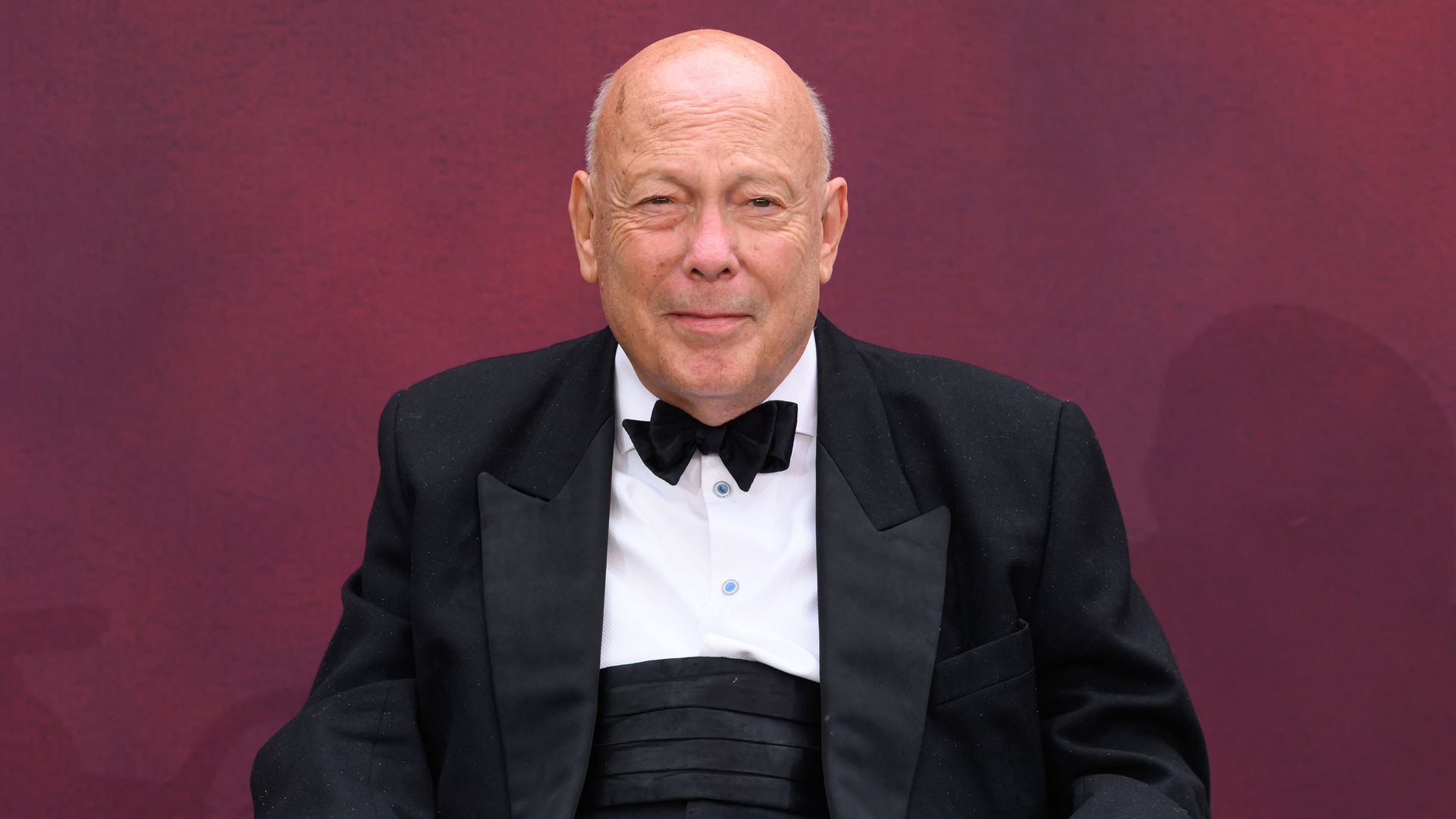
While Maggie Smith, Hugh Bonneville and Michelle Dockery are the faces that spring to mind when you think of Downton Abbey, the hugely popular TV and film series would never have become what it was without the franchise's creator, Julian Fellowes, who wrote every episode of the TV show and films too. "Julian Fellowes is undoubtedly one of Britain’s most successful writers, having established himself as the king of period dramas," affirms HELLO!'s TV writer Abby Allen. "His impact on Downton Abbey is unparalleled, making him as integral to the show as leading stars Hugh Bonneville and Michelle Dockery."
While Julian, who is also a Member of the House of Lords, seems incredibly strong, the 76-year-old shared that he has been contending with an essential tremor for several years, which caused involuntary shaking of his hands. The producer said he was "in denial" about his condition, telling The Times: "It takes a while before you admit you've got a condition that, until recently, you just had to accept. I found that quite hard." On how the tremor impacted his day-to-day life, Julian explained: "Doing up buttons, fastening a tie — everything became a labour. My cufflinks would go flying off. It is very, very depressing and upsetting — and can feel quite a burden."
The way in which the condition impacted the Downton Abbey creator the most might come as a surprise, with the Conservative peer sharing: "I used to have rather pretty handwriting. I was a little bit vain about it. It seemed curiously ironic that I should be attacked in my handwriting. I know many people have much worse to put up with, and I appreciate that, but nevertheless I felt a part of me had gone."
He turned to typing instead to complete the scripts for Downton Abbey The Grande Finale, noting that his shaking hands impaired his ability to type, slowing the process of script writing. "It would be full of mistakes. I would have to go back over everything two or three times."
What is an essential tremor?
The NHS explains an essential tremor as a neurological (brain and nerves) disorder that causes involuntary shaking of parts of the body. The healthcare provider explains that the severity of essential tremor varies. "In most people, it is mild and they won't need to see a doctor about it, but in others it can make simple tasks such as drinking a cup of tea or writing very difficult."
Treatment for an essential tremor
Julian opted to treat his tremor via an MRI-guided focused ultrasound, which sees ultrasound waves directed at a precise point in the brain, burning a tiny lesion that interrupts the faulty signals causing the shaking. Of the surgery, Julian admitted: "It was one of those terrifying procedures where you're kept awake the whole time," he says. "They put this metal crown on to keep your head still, which is quite unpleasant. But the medical team were very nice."
The procedure took about two hours and the results were immediate, but it is important to note that it is not a cure, though studies have shown it can result in significant relief for patients.
Julian Fellowes' mobility issues
On top of his essential tremor, Julian Fellowes has been struggling with mobility, telling Deadline in June this year: "I've got these mobility issues, and I use a wheelchair rather more than I would like, but that's not the same as feeling ill. I think you can stand anything like that as long as you feel OK, and that's the position I'm in now. I have to use a wheelchair because my spine doesn't work as it used to. But in terms of feeling OK and getting on with things and working and all that stuff, I'm fine. There are many people much worse off than I am."